
If you have specified valves for a piping system, you have almost certainly faced the question: ball valve or check valve? The two look nothing alike, serve fundamentally different purposes, and yet they are constantly compared side by side — in procurement spreadsheets, on P&ID markups, and during design reviews.
The short answer: a ball valve is a manual or actuated on/off control device, while a check valve is an automatic one-way gate that prevents reverse flow. But the practical differences run deeper than that. They reach into pressure ratings, installation sequence, failure modes, and lifecycle cost. This article maps out those differences and, just as importantly, explains how these two valves work together in a well-designed system.
What Is a Ball Valve?
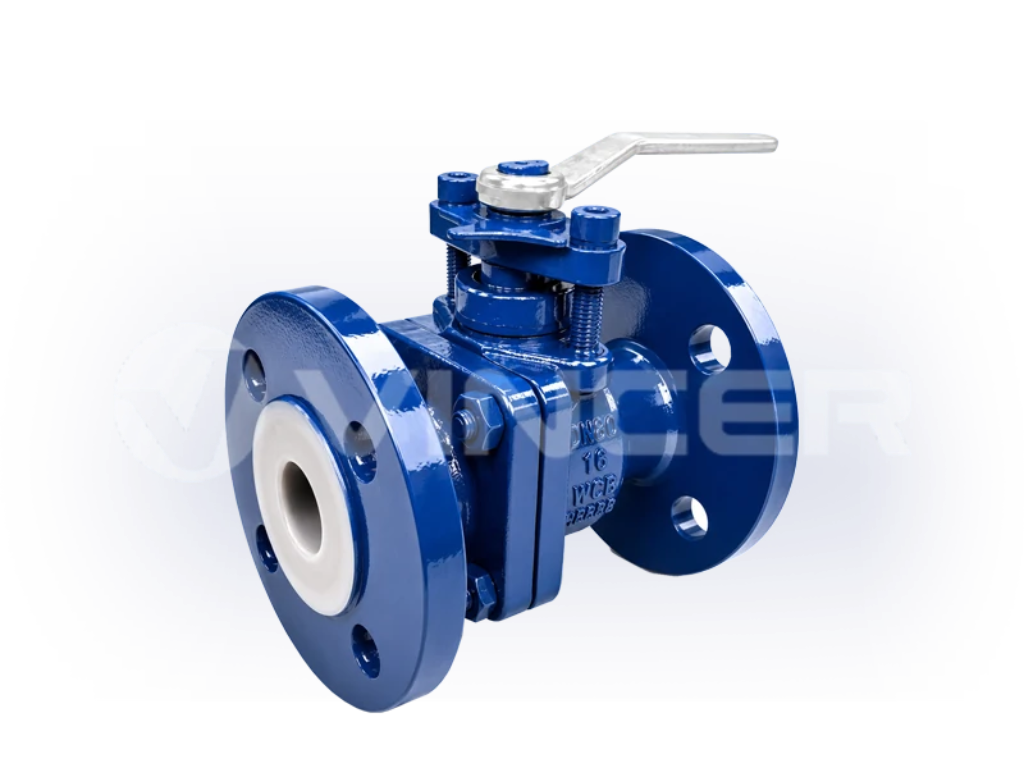
A ball valve is a quarter-turn valve that controls flow using a hollow, rotating ball with a bore through its center. Turn the handle 90 degrees: the bore aligns with the pipeline and fluid passes through. Turn it back: the solid ball face blocks the passage completely.
The ball valve earns its place in industrial piping through the quality of its shutoff. A full-port ball valve, where the bore diameter matches the pipe’s inner diameter, creates virtually no pressure drop when open. When closed, a metal-seated ball valve can achieve Class VI bubble-tight sealing — zero visible leakage. Few other valve types combine low open resistance with absolute closed isolation this well.
Class VIBubble-Tight Shutoff · Zero Visible Leakage
Ball valves are found wherever operators need reliable on/off control: pump isolation, tank outlet shutoff, emergency shutdown (ESD) loops, and any application where a line must be positively sealed for maintenance. They can be operated manually with a hand lever or gearbox, or automated with electric or pneumatic actuators for remote and fail-safe operation.
What Is a Check Valve?
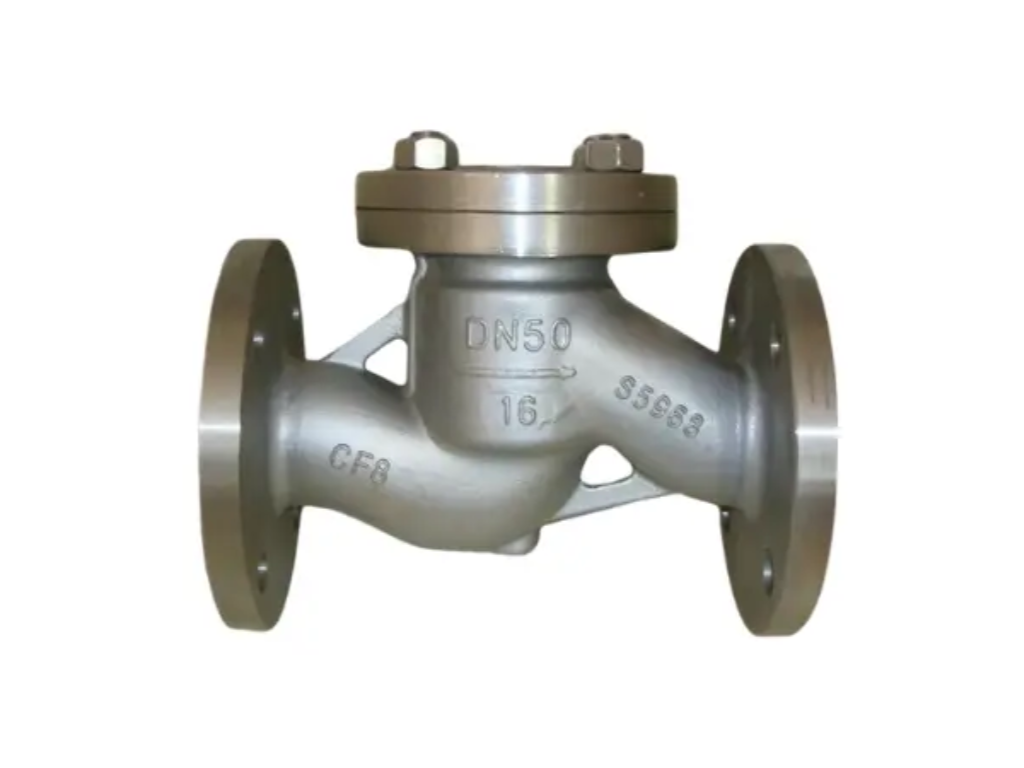
A check valve — also called a non-return valve or one-way valve — is a self-acting device that allows fluid to flow in only one direction. When forward pressure exceeds the valve’s cracking pressure, the internal mechanism (a disc, ball, poppet, or piston) lifts off its seat and lets fluid pass. The moment flow stops or tries to reverse, the mechanism closes against the seat and blocks the backflow. All of this happens automatically, without any external command.
This autonomy is both the check valve’s greatest strength and its hidden weakness. It needs no power supply, no control signal, and no operator. It can be installed in a pipe trench, on a rooftop, or underwater and will keep doing its job. But it also cannot be commanded open or closed. When it fails, it often fails silently, offering no external indication that backflow protection has been lost.
Four common check valve types cover most industrial applications:
-
Swing check: A hinged disc swings open with forward flow and swings shut by gravity and reverse flow. Best for horizontal runs and large diameters where low pressure drop matters.
-
Ball check: A weighted or spring-assisted ball lifts off the seat. The ball’s rolling action provides a self-cleaning effect, making it suitable for viscous or particle-laden fluids.
-
Spring / poppet check: A spring-loaded disc or poppet provides positive closure regardless of orientation. Faster closing than swing types, which reduces water hammer, at the cost of slightly higher cracking pressure.
-
Piston check: A weighted piston rides up and down within a guided cylinder. Offers a dashpot-like dampening effect that smooths out pulsating flow, commonly used in compressor discharge lines.
Ball Valve vs Check Valve: 5 Critical Differences Every Engineer Should Know
Before comparing individual dimensions, the core distinction is worth stating plainly: a ball valve is a device you command. It does nothing until you or your PLC tell it to act. A check valve is a sentinel. It stands guard automatically, and you will not know it has failed until downstream equipment is already damaged. Understanding this split explains everything that follows.
Primary Function: Active Flow Control vs Automatic Backflow Prevention
The most fundamental divide between these two valves is what they exist to do.
A ball valve controls flow on demand. When the system needs to start, stop, or isolate a section of pipe, the ball valve executes that command — manually via a hand lever, or automatically through an electric or pneumatic actuator receiving a control signal. The operator decides when it opens and closes.
A check valve prevents a specific failure mode: reverse flow. If a pump trips, a check valve on its discharge line closes before the water column can slam backward into the impeller. If a compressed air tank loses pressure, the check valve stops the downstream piping from back-feeding. No one needs to notice the event for the protection to work. It happens purely on physics.
Why this matters: Treating a ball valve as a substitute for a check valve is dangerous. “I will just close it when backflow happens” assumes you will notice in time. Backflow events unfold in seconds. By the time an operator reaches the valve, the pump may already be damaged.
Key Insight: A ball valve is a device you command. A check valve is a sentinel — it stands guard automatically, and you will not know it has failed until downstream equipment is already damaged.
Operation Method: Manual or Actuated vs Fully Self-Actuating
Ball valves require an energy source to change state. In the simplest case, that energy is a maintenance technician turning a hand lever. In automated installations, it is 24 VDC, 110 VAC, 220 VAC, or 380 VAC power feeding an electric actuator, or 4–7 bar compressed air driving a pneumatic rack-and-pinion assembly.
Check valves have no such requirement. The fluid’s own pressure is the energy source. Forward flow pushes the mechanism open; its absence allows gravity, spring force, or reverse pressure to close it.
The engineering implication is straightforward but often overlooked during layout: a ball valve must be installed where someone or something can reach it. A check valve can live anywhere the pipe runs — inside a buried vault, at the top of a vertical riser, behind a wall. In pumping stations where floor space is tight and access is limited, this distinction alone often dictates which type goes where.
Flow Direction: Bidirectional vs Strictly Unidirectional
A standard ball valve, when open, allows flow in either direction. (Specific high-pressure metal-seated designs with a preferred shutoff direction exist, but these are special cases, not the norm.) This bidirectional capability makes ball valves versatile for lines where flow direction might reverse during different operating modes.
A check valve is unidirectional by design, and getting this wrong has real consequences. Every check valve body carries a flow direction arrow. If the arrow points the wrong way, reverse flow will push the mechanism open rather than closed, rendering the valve completely useless. The failure is binary: either the valve cannot open (no flow through the system, immediately obvious) or it cannot close (backflow protection is gone, silent and catastrophic).
Swing check valves also have an orientation dependency beyond direction: they rely on gravity to assist closure, so vertical installation typically requires upward flow. Spring-loaded check valves are more forgiving, functioning in any orientation, which makes them the safer choice when pipe routing is complex.
Installation Direction Is Not Optional: Installing a check valve backward produces one of two outcomes — zero flow (immediately obvious) or zero backflow protection (silent, catastrophic). There is no middle ground.
Pressure and Temperature Tolerance
Metal-seated ball valves stretch across a remarkably wide operating envelope. Depending on body material and seat design, they can handle Class 150 through Class 2500 (PN 20 to PN 420), with temperature ranges spanning cryogenic service (-196 °C) to high-temperature alloys exceeding 800 °C. A standard WCB cast-carbon-steel ball valve with PTFE seats is rated to roughly 200 °C; swap to RPTFE for 230 °C, PEEK for 260 °C, or a full metal seat for high-temperature hydrocarbon service.
Check valves operate in a narrower band. Most industrial check valves top out at Class 600, and their temperature ceiling is usually constrained not by the body material but by the internal dynamic components. A spring inside a spring-loaded check valve will lose temper at sustained high temperature long before the valve body itself reaches its material limit. A swing check’s hinge pin, operating in a hot, corrosive fluid with no lubrication, is a common failure point that does not exist on a static-sealing ball valve.
| Operating Parameter | Ball Valve (Typical Range) | Check Valve (Typical Range) |
| Pressure Class | Class 150–2500 | Class 125–600 |
| Temperature (PTFE seat) | -29 °C to 200 °C | N/A (metal/metal seat typical) |
| Temperature (metal seat) | -196 °C to 800 °C+ | -29 °C to 540 °C |
| Key Limiting Factor | Seat material | Internal spring or hinge material |
Cost Comparison: Initial Purchase vs Lifecycle Economics
Price tags tell only part of the story, but they set expectations. For a DN50 flanged valve in WCB cast carbon steel, a manual ball valve typically runs $50–150, while a swing check valve of the same size and material costs $40–120. In 316 stainless steel, those numbers shift to roughly $150–400 for the ball valve and $100–300 for the check valve. Add an electric actuator to the ball valve and the package climbs by $200–800 depending on torque requirements and control features.
But the cost conversation should not end at the purchase order. A check valve that costs $80 to buy protects a pump that costs $3,000–15,000 to repair or replace. A ball valve with zero-leakage shutoff that enables maintenance without a system-wide shutdown pays for itself the first time it avoids a production stop.
The right question is not “which valve is cheaper?” but “what is the cost of the failure this valve is preventing?” The answer usually dwarfs the price difference.
-
Swing Check WCB: $40–120
-
Ball Valve WCB: $50–150
-
Swing Check SS316: $100–300
-
Ball Valve SS316: $150–400
-
(DN50 flanged, approximate ranges. Actuator adds $200–800.)
When to Use Each Valve: A Quick Decision Table
The preceding sections describe how these valves differ. The table below translates those differences into a practical selection guide: given a specific need, which valve answers it, and why.
| If You Need To… | Choose | Why |
| Prevent backflow automatically without human or control-system intervention | Check Valve | Self-actuating — closes on flow reversal within milliseconds |
| Manually or remotely shut off flow for equipment isolation | Ball Valve | Positive bubble-tight shutoff; Class VI sealing available |
| Protect a pump, compressor, or upstream equipment from reverse flow damage | Check Valve | Installed immediately at pump discharge; first line of defense |
| Isolate a section of pipe for maintenance without draining the system | Ball Valve | Reliable zero-leakage isolation in both directions |
| Handle pressure classes above Class 600 | Ball Valve | Standard designs available to Class 2500 |
| Install in a remote, hard-to-access location where no operator will ever visit | Check Valve | Zero external energy or human access required |
| Achieve emergency shutdown (ESD) with a fail-safe close on loss of power or air | Ball Valve | Spring-return actuators provide fail-close or fail-open on signal loss |
| Ensure one-way flow only — no exceptions | Check Valve | Designed exclusively for unidirectional flow; flow arrow is mandatory |
Most industrial systems need both — the check valve protecting equipment automatically, the ball valve giving operators controlled isolation points.
How Ball Valves and Check Valves Work Together: Pump Discharge and Beyond
In real piping design, ball valves and check valves are not alternatives. They are a fixed pairing, and the sequence in which they are installed is not negotiable. The standard layout, repeated across thousands of pump stations, compressor skids, and process lines worldwide, is:
Pump → Check Valve → Ball Valve → Downstream System
Here is why this order exists, and where else the same pairing logic applies.
The Standard Pump Discharge Configuration: Check Valve Before Ball Valve
In a pump discharge line, the check valve sits closest to the pump nozzle. Its job is to slam shut the instant the pump stops, preventing the fluid column in the downstream piping from reversing direction and spinning the impeller backward or hammering the pump casing. Water hammer from a swing check that closes too slowly can generate pressure spikes 3 to 5 times the normal operating pressure — enough to crack flanges or rupture gaskets. Spring-loaded check valves reduce this risk with faster, controlled closure.
The ball valve follows after the check valve, not before. This order matters. Every check valve eventually wears out or jams. When it does, you need to isolate it for repair. With the ball valve downstream, you close it, and the check valve is safely trapped between the pump (valved off on the suction side) and the closed ball valve. No need to drain kilometers of downstream piping. Reverse the positions — ball valve between pump and check valve — and the check valve sits downstream of your only isolation point, unreachable without draining the entire discharge header.
A practical detail that often gets skipped in spec sheets: leave 5 to 10 pipe diameters of straight run between the pump discharge flange and the check valve inlet. The pump impeller generates turbulent, swirling flow. If that turbulence hits a check valve disc before it settles into a uniform velocity profile, the disc flutters, cycling between partially open and closed and wearing the hinge pin and seat at an accelerated rate. A short straight spool piece costs almost nothing and can extend the check valve’s service life by years.
Flow Diagram & Annotations:
-
Pump → Check Valve → Ball Valve → System
-
Annotation 1: 5–10 pipe diameters straight run between pump and check valve
-
Annotation 2: Correct sequence. Reversing check & ball traps the check valve without isolation.
For engineers specifying both valve types in a pump discharge setup, sourcing ball valves and check valves from a single manufacturer simplifies procurement in two concrete ways: flange drilling patterns and pressure ratings are guaranteed to match without cross-referencing two separate catalogues, and delivery timelines for both valves can be coordinated under a single purchase order. Vincer, for example, produces full-port and V-port ball valves alongside swing, ball, spring, and piston check valves — with material options spanning 50+ grades including SS316, WCB, and PVDF — so the valve pair can be matched to the same media and service conditions without compromise.
Other Common System Configurations
The pump discharge layout is the most common pairing, but the same logic — check valve for automatic protection, ball valve for controlled isolation — shows up across other process systems:
-
Compressed air systems: A check valve at the receiver tank outlet prevents stored air from flowing backward into the compressor head during unload cycles. A ball valve downstream lets maintenance isolate the distribution header without venting the entire tank.
-
Chemical injection lines: A check valve (often a double-check assembly for contamination prevention) stops the main process stream from back-flowing into the injection quill. A ball valve upstream of the injection point provides a positive shutoff for injector replacement.
-
Boiler feedwater: The check valve on the feedwater line prevents steam or hot water from reversing into the feed pump and deaerator during pressure transients. The ball valve downstream isolates the boiler side for inspection without shutting down the feed system.
Maintenance Schedules and Failure Modes: What Your Valve Manual Leaves Out
Most valve comparison articles end at the selection guide. But once the valves are installed, what actually happens over years of service? The two types age very differently, and the maintenance strategy needs to account for that asymmetry.
Ball Valve Maintenance: A Quarterly Checklist
Ball valves have one well-known weakness: if left in one position for months or years, the stem can seize. The packing around the stem hardens, corrosion builds between the stem and body, and the torque required to turn the handle climbs until someone snaps the lever or strips the gearbox.
The fix is simple and costs nothing: cycle every ball valve in the plant from fully open to fully closed and back once per quarter. This single action redistributes lubricant in the packing, breaks up early-stage corrosion on the stem, and confirms the valve will still operate when an emergency demands it. For valves in corrosive or high-temperature service, increase the frequency to monthly.
Beyond cycling, the annual checklist covers three items: (1) check the stem packing area for visible leakage — ISO 15848 defines fugitive emission classes for this exact inspection; (2) verify actuator torque settings and limit switch positions have not drifted; (3) for metal-seated valves in abrasive service, borescope the ball and seat for scoring. Every 3 to 5 years, depending on cycle count and media aggressiveness, plan to replace stem packing, seat rings, and actuator gearbox lubricant. A soft-seat PTFE ball valve in clean water service may run 5 to 8 years between seat replacements; the same valve in a chemical line with frequent cycling may need seats at the 2- to 4-year mark.
Timeline Summary:
-
Every Quarter: Cycle valve fully open/closed. Costs nothing. Prevents stem seizure.
-
Every Year: Check stem packing, actuator torque, limit switches. ISO 15848 reference.
-
Every 3–5 Years: Replace stem packing, seat rings, gearbox lubricant.
-
Every 5–8 Years: Seat replacement (clean water). 2–4 years for chemical service.
Check Valve Maintenance and the Silent Failure Problem
Check valves fail differently — and more dangerously — than ball valves. A ball valve that cannot close is obvious: the system cannot be isolated. A check valve that is stuck open looks completely normal from the outside. Flow passes through, pressures read within spec, and the control room sees nothing unusual. The only clue is that backflow protection no longer exists, and the first confirmation may be a destroyed pump.
Three failure modes account for nearly all check valve field problems:
-
Stuck open (most dangerous): Debris, scale, or corrosion prevents the disc, ball, or poppet from seating fully. Reverse flow leaks past, slowly at first, then progressively as erosion enlarges the gap. Detection: listen for flow noise during pump shutdown, or install a downstream pressure gauge and watch for pressure decay that should not happen.
-
Stuck closed (immediately obvious): The mechanism jams against the seat and will not lift. No flow reaches the downstream system. The problem announces itself immediately, which is ironically safer than Mode 1.
-
Chatter / flutter (slow destruction): The disc or ball oscillates between partially open and closed, driven by flow pulsations or operating the valve at a flow rate below its minimum full-open velocity. Swing checks typically need 1 to 2 m/s of sustained forward velocity to swing fully open and stay there; below that threshold, the disc hovers in the flow stream, hammering the seat and hinge until one of them fails.
An annual check valve inspection catches most degradation before it becomes failure. Listen with a contact stethoscope for internal flutter during operation; open the valve for a visual examination of the seating surface and hinge or spring assembly. In clean water service, a well-installed check valve may run 5 to 7 years between overhauls. In slurry or particle-laden service, cut that to 2 to 3 years. High-temperature steam applications demand annual spring tension testing; a spring that has lost 20 to 30 percent of its original force may still hold against normal back-pressure but fail during a pressure surge.
If your maintenance team is stretched thin, Vincer’s engineering support provides remote diagnostics for actuator faults, seal leakage, and coil burnout — with a 12-hour response window and free replacement parts within warranty — extending your in-house maintenance capability without adding headcount.
.webp)
Common Mistakes to Avoid
The theory only becomes useful when it prevents real-world errors. These five mistakes recur across industries and experience levels. Each is avoidable with the right mental checklist.
-
Substituting a ball valve for a check valve to save cost. A ball valve will not close itself when the pump trips. By the time someone notices reverse flow, the impeller is already spinning backward or the casing has taken a water hammer hit. The money saved on the check valve is a fraction of the pump repair cost.
-
Using a check valve for throttling or flow regulation. Check valves are binary devices. They are either open or closed. Operating one in a partially open state forces the internal mechanism to flutter violently against the seat, accelerating wear from years to weeks. If flow control is needed, install a globe valve or a V-port ball valve, and keep the check valve where it belongs: fully open at design flow.
-
Ignoring the flow arrow on a check valve body. The arrow is not a suggestion. An incorrectly oriented check valve will either block all flow (if installed backward in a normally forward-flowing line) or, worse, will open under reverse flow and provide zero backflow protection. Either outcome defeats the purpose of installing the valve in the first place.
-
Placing the ball valve between the pump and the check valve. The sequence matters: Pump → Check Valve → Ball Valve. Reversing the check and ball positions traps the check valve downstream of the only isolation point. When the check valve eventually needs repair, you will have to drain the entire discharge header to reach it. That is a half-day job that should have been a 20-minute isolation.
-
Ignoring media compatibility when selecting check valve type. A standard swing check with a metal hinge pin will seize within weeks in a slurry line with abrasive solids. A spring-loaded poppet check with a light-gauge spring will lose tension in months on a high-temperature steam line. Ball check valves, with their rolling self-cleaning action, are generally the better starting point for dirty or viscous service. The rotating ball continuously wipes the seat and resists debris accumulation.
Quick Reference: 5 Rules to Remember
-
Never substitute a ball valve for a check valve
-
Check valves cannot throttle — use globe or V-port ball
-
Follow the flow arrow — always
-
Sequence: Pump → Check → Ball, never reversed
-
Match check valve type to your media.
Closing Note
Choosing between a ball valve and a check valve is the wrong framing. The real task is understanding where each belongs in a system — and, more often than not, how to place them in series so the check valve guards the equipment automatically while the ball valve gives operators the isolation points they need for maintenance. Getting the sequence, sizing, and material selection right at the specification stage avoids the costly fixes that fill maintenance backlogs: seized stems, silent check failures, water hammer damage. A correctly specified valve pair can run for years with minimal intervention. A poorly chosen one will make itself known within the first quarter.
References
-
Philip L. Skousen. Valve Handbook, 3rd Edition. McGraw-Hill, 2011.
-
ASME B16.34. Valves — Flanged, Threaded, and Welding End. American Society of Mechanical Engineers.
-
API Standard 6D. Specification for Pipeline Valves. American Petroleum Institute.
-
ISO 15848-1. Industrial valves — Measurement, test and qualification procedures for fugitive emissions. International Organization for Standardization.
 English
  French
  Spanish
  Italian
  German
  Dutch
Dutch  Portuguese
  Korean
  Russian
  Chinese
  Finnish