
Full Bore vs. Reduced Bore — What’s the Actual Difference?
At its simplest, the distinction is one number: the diameter of the hole through the ball.
A full bore (FB) ball valve has an internal bore diameter equal to the pipe’s inside diameter. Open the valve, and the fluid sees an uninterrupted cylinder — no constriction, no step change in cross-section. A reduced bore (RB) ball valve has a bore roughly one nominal pipe size smaller. In a 6-inch line, the full bore valve presents a ~154 mm opening; the reduced bore version narrows to ~102 mm — equivalent to a 4-inch pipe.
That single dimension cascades into everything else.
Bore Comparison (6″ line):
-
~154 mm: Full Bore
-
~102 mm: Reduced Bore
| Parameter | Full Bore | Reduced Bore | Why It Matters |
| Bore-to-Pipe Ratio | ~100% of pipe ID | ~70–80% of pipe ID | Determines flow velocity through the valve |
| Flow Coefficient (Cv) | Baseline (highest for size) | 2–3× lower than FB of same nominal size | Affects pump sizing and energy consumption |
| Pigging Capability | Yes — all pig types pass | No — pig gets stuck or damaged | Non-negotiable for pipeline operations |
| Weight | Heavier (larger ball and body) | ~30% lighter | Impacts structural support and installation cost |
| Relative Cost | Historically 15–40% more | Lower baseline | Gap is shrinking — more on this below |
Think of it this way: a reduced bore valve is like a highway that suddenly narrows from four lanes to three. At low traffic, nobody notices. At rush hour — or when a wide load needs to pass — that single pinch point defines the entire system’s capability.
How Flow, Pressure Drop, and Pigging Shape the Real-World Choice
The bore difference looks clear on paper. The real question is: when does it actually matter? The answer depends on what’s flowing through your pipe, how far it’s going, and whether that line will ever need to be cleaned or inspected from the inside.
Here’s the core thesis: deciding between FB and RB isn’t about which one is “better” — it’s about whether your fluid, your pipeline length, and your future operational needs make the bore restriction a real constraint or a non-issue.
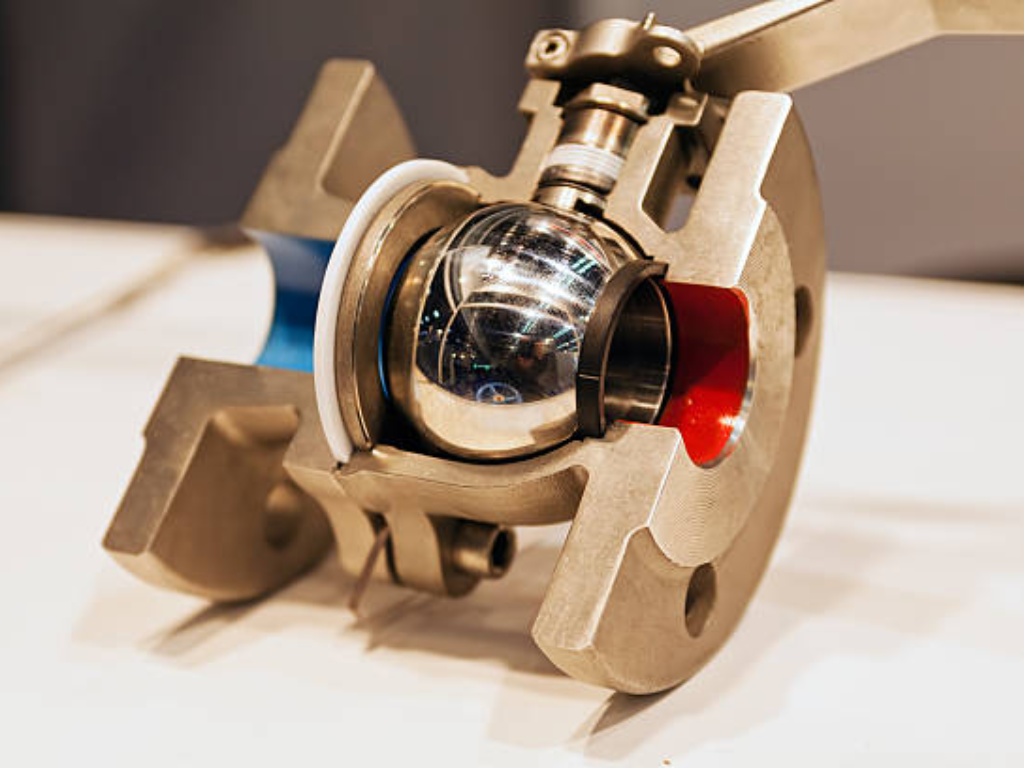
Pressure Drop & Flow — Why the Numbers Don’t Tell the Whole Story
A reduced bore valve creates a venturi effect: fluid accelerates through the narrowed bore, then decelerates as the pipe widens again. Textbook physics says this costs you pressure. In the real world, the significance of that loss depends entirely on context.
For short process runs with clean, single-phase fluids — cooling water loops, instrument air headers, nitrogen purge lines — the pressure drop across a reduced bore valve is often negligible. One experienced mechanical engineer on Eng-Tips put it bluntly: “Whenever I have calculated the loss through a standard-port valve, the pressure drop seemed to start with a decimal and have a couple of zeros before a significant digit.” In these applications, the ΔP from elbows, tees, and other fittings typically dominates — the valve is just another minor loss in the system.
“Whenever I have calculated the loss through a standard-port valve, the pressure drop seemed to start with a decimal and have a couple of zeros before a significant digit.”
— Experienced mechanical engineer on Eng-Tips
The picture flips in three scenarios:
-
Long transmission pipelines. When a line stretches hundreds of meters or kilometers, the accumulated pressure drop across dozens of valves becomes a real pumping cost. A single reduced bore valve might cost you 0.01–0.05 bar. Fifty of them, running 24/7, translate into measurable kilowatt-hours on your electricity bill — year after year.
-
Multiphase and solids-laden flow. The venturi effect behaves differently when the fluid isn’t uniform. In sand-laden crude or slurry service, the velocity spike through a reduced bore accelerates erosion at the ball and seat — even if the steady-state ΔP looks mild on a spec sheet. Research from Southwest Research Institute found that while permanent pressure loss from FB and RB valves converges at roughly 10 pipe diameters downstream in single-phase flow, that convergence does not hold for multiphase or particle-laden service. The erosion risk alone can make full bore the only defensible engineering choice.
-
Pump and compressor suction lines. This one is non-negotiable. Any restriction on the suction side reduces the Net Positive Suction Head available (NPSHa), pushing the pump closer to cavitation. A reduced bore valve here isn’t just a minor efficiency loss — it can damage equipment.
Pigging Compatibility — The Line in the Sand
If there’s one factor that makes the FB-vs-RB decision binary, it’s pigging.
Pipeline pigs — cleaning pigs, gauging pigs, and in-line inspection (ILI) smart pigs — are rigid or semi-rigid devices sized to the pipe’s internal diameter. They travel through the line propelled by product flow, scraping debris, removing wax buildup, or scanning for corrosion and wall loss with magnetic flux leakage (MFL) or ultrasonic sensors.
A reduced bore valve is a wall. The pig’s sealing disc, designed to match the full pipe ID, cannot compress through a bore that’s one size smaller. Best case: the pig stops at the valve, and your pigging program fails for that entire line segment. Worst case: the pig jams, deforms, or breaks apart inside the valve — and now you have a stuck pig, a partially blocked line, and a multi-day shutdown to cut the valve out and repair the damage.
This is why API 6D mandates full bore for pipeline valves, and why most EPC pipe class specifications automatically default to full bore on any hydrocarbon or potentially piggable line. It’s also the reason many experienced pipeline engineers have adopted a simple rule: if there’s any chance this line will ever be pigged — even ten years from now — spec full bore. The cost of retrofitting a single reduced bore valve later (shutdown, hot work permit, crane, crew, production loss) typically exceeds the upfront savings of every reduced bore valve on the project combined.
The Retrofit Math
Retrofitting one RB valve for pigging costs 50× or more what you saved by choosing RB. The shutdown, hot work permit, crane mobilization, and lost production turn a “budget choice” into the most expensive valve on your line.
What Does Full Bore Actually Cost? — Beyond the Price Tag
Most articles on this topic stop here. They miss the story that actually matters.
The conventional wisdom is simple: full bore costs more because it uses more material (a larger ball, a larger body, more machining time). The number thrown around is “15–40% more expensive.” That was true a decade ago. Today’s market tells a more nuanced story, and understanding it can save you from a costly procurement mistake.
The price gap between full bore and reduced bore is no longer what your budget spreadsheet assumes.
The Shrinking Price Gap — A Market Shift Nobody Talks About
When David Simpson — a pipeline engineer with over 30 years of experience, known as “zdas04” on Eng-Tips — looked at his recent valve quotes, he noticed something that contradicted everything his career had taught him. “When I started doing pipeline work, reduced bore valves were about 25% less expensive,” he wrote. “Today you actually pay a premium for reduced bore valves with several suppliers.”
The reason is manufacturing economics, not materials. In the 6-inch to 24-inch carbon steel range — the workhorse segment for most process and pipeline applications — full bore has become the standard production item. The factories are set up for it. The casting molds, the machining fixtures, the inspection gauges — everything is optimized for full bore volumes. Order a reduced bore valve in this size range, and you’re effectively placing a special order: smaller production run, separate setup, higher per-unit overhead. The “cheaper” option became the non-standard option.
This doesn’t hold everywhere. Below 2 inches, reduced bore still carries a meaningful cost advantage — the material delta matters more at small scale. Above 24 inches, the material savings of reduced bore re-emerge as dominant, and the manufacturing complexity of very large full-bore castings can flip the economics back. And in exotic alloys — duplex stainless, Inconel, titanium — the material cost of that larger ball and body in a full bore design will always command a premium, because the raw material price per kilogram dwarfs the manufacturing setup cost.
But for the majority of industrial ball valve purchases — 2″ through 24″, carbon or standard stainless steel — the era of “reduced bore is the budget choice” is over. It’s more accurate to say: get quotes for both, and don’t be surprised when they’re within single-digit percentages of each other.
Market Reality: Reduced Bore Is Now the Special Order
For 2″–24″ carbon and stainless steel — the most commonly purchased size-and-material range — full bore is the production standard. RB has become the deviation that costs extra.
Total Cost of Ownership — The Spreadsheet Your Supplier Won’t Show You
Even if the purchase price were identical, the real comparison belongs on a different spreadsheet.
Total Cost of Ownership for a valve spans four line items: purchase price, operating energy, maintenance cost, and future modification risk. Let’s walk through each:
-
Operating energy. The accumulated pressure drop across every valve in a continuous-duty pipeline translates directly into pump or compressor power. While a single reduced bore valve in a short branch line may contribute a trivial ΔP, the calculation looks different for a main transmission line with 40 or 50 valves. The pump works against the sum of all restrictions — and that sum includes every reduced bore in the loop. Over a 15-year service life, the energy cost difference can erase the initial purchase savings several times over.
-
Maintenance cost. In clean, non-abrasive service, both bore types have similar wear profiles. But introduce even a small amount of entrained solids — sand, scale, catalyst fines — and the elevated velocity through a reduced bore accelerates seat and ball erosion. A valve that might last 8 years in full bore configuration could need replacement in 4–5 years with a reduced bore — and the replacement cost includes not just the new valve, but the labor, the crane, and the production downtime.
-
Future modification risk. This is the hidden cost that procurement spreadsheets never include, and it’s the one that seasoned engineers lose sleep over. Your facility today may not need pigging. In five years, a new operating regulation, a changed crude slate, or an integrity management requirement could make inline inspection mandatory. If you installed reduced bore valves on trunk lines, you’re now looking at a valve replacement program — cutting out and replacing every RB valve along the pigging path, during a shutdown, at a cost that makes the original “savings” look absurd.
Total Cost Breakdowns:
-
Purchase Price: Gap shrinking to single digits; in some sizes RB now costs more at order time.
-
Operating Energy: Cumulative pump cost over 15-year life can erase initial savings several times over.
-
Maintenance: Elevated velocity through RB accelerates seat and ball erosion, halving service life in solids-laden service.
-
Modification Risk: The hidden-cost wildcard. Future pigging requirement means cutting out every RB valve at 50× the original “savings.”
This is why more and more project engineers are doing TCO math before procurement — and why the conclusion of that math increasingly favors full bore as the default, not the upgrade.
When you evaluate suppliers through this lens, the checklist goes beyond the price-per-unit column. Look for manufacturers who provide full material test certificates (MTCs) for both raw materials and finished products, hold internationally recognized certifications such as ISO 9001, CE, and SIL, and can deliver standard products within 7–10 business days. These operational signals matter more to your project timeline and long-term reliability than a 5% price difference on a line-item quote. Companies like VINCER, with five certifications including FDA and RoHS alongside standard industrial credentials, demonstrate the kind of documented quality commitment that translates into fewer surprises during commissioning and operation.
Making the Right Call — A Decision Framework That Sticks
So: which one should you pick?
The right answer isn’t “always X.” It’s a decision sequence. Apply the constraints first, then weigh the trade-offs. Here’s the framework, in the order that experienced engineers actually use.
Gate 1: Absolute constraints first. Before thinking about cost or weight or preferences, check whether your application has a hard exclusion. There are five:
When Full Bore Is Non-Negotiable
Run through this pre-flight checklist. If any of these conditions are true, you’re locked into full bore — no further debate needed:
-
The line requires pigging — now or potentially in the future. This is the single clearest binary in valve selection. If a pig needs to pass, the bore must match the pipe ID. No alternative exists. No workaround exists. Don’t bet your future operational flexibility on a “probably won’t need it” assumption.
-
The fluid contains solids, is highly viscous, or is multiphase. Sand, wax, catalyst particles, entrained water in crude — anything that isn’t a clean single-phase liquid or gas means the bore restriction becomes a collection point, an erosion hot spot, or both.
-
The valve is on a pump or compressor suction line. Suction-side pressure drop costs you NPSH margin. Cavitation damage to a pump impeller costs orders of magnitude more than any valve bore premium.
-
The valve sits upstream or downstream of a flow meter. Flow measurement accuracy depends on a stable, fully developed velocity profile. A bore change within 10 diameters of the meter disturbs that profile and introduces measurement error. Custody transfer and fiscal metering applications have zero tolerance for this.
-
Your pipe class specification mandates full bore. This one requires no engineering judgment — the spec is the spec. Proposing a deviation after bid award is not just a technical argument; it’s a credibility problem with your client.
Gate 1 Result:
If any condition matched → Full Bore. If none matched → continue below.
When Reduced Bore Makes Sense — And the Case for Defaulting to Full Bore
If none of the five hard constraints apply — your fluid is clean and single-phase, your line is non-piggable, you’re not on a suction line or near a meter — reduced bore becomes a legitimate option. The standard use cases are well-established: utility branch lines (cooling water bypasses, instrument air drops), short-run process connections where the ΔP contribution is truly negligible, tight-fit OEM equipment where every kilogram and centimeter of installation envelope counts, and small-bore instrument root valves under 2 inches.
But the conversation has shifted.
A growing number of experienced pipeline and process engineers have converged on what you might call the “regret minimization” principle. Simpson’s formulation on Eng-Tips captures it: “Always spec full bore unless there is a compelling reason not to.”
-
First, the cost argument for reduced bore has collapsed in the most commonly purchased size-and-material range. When the price difference between FB and RB is in the low single digits — or occasionally inverted — there’s no financial case to accept the operational limitations of reduced bore.
-
Second, you cannot predict your facility’s pigging requirements a decade out. Regulatory landscapes shift. Integrity management programs expand. Pipeline operators worldwide are running more in-line inspection than ever before, driven by both regulation and insurance requirements. A valve installed today may need to pass a smart pig in 2032. If you chose reduced bore, you chose a future retrofit.
-
Third, the regret cost is wildly asymmetric. The money you “save” by choosing reduced bore is measured in hundreds of dollars per valve. The cost to swap even one reduced bore valve for full bore later — during operations, on a live system — is measured in tens of thousands, between shutdown coordination, hot work permits, crane mobilization, and lost production. The ratio is easily 50:1 or worse.
“Always spec full bore unless there is a compelling reason not to.”
— David Simpson, pipeline engineer, 30+ years
Consensus Points:
-
Cost collapsed. Price difference in the most common sizes is single digits or inverted — no financial case to accept RB limitations.
-
Future uncertainty. You cannot predict pigging requirements a decade out. A valve installed today may need to pass a smart pig in 2032.
-
Asymmetric regret. Savings are hundreds per valve; swapping one later costs tens of thousands. The ratio is 50:1 or worse.
Exceptions exist, and they’re important. This principle doesn’t mean full bore is always right. If you’re ordering a 36-inch duplex stainless valve, the material premium for full bore is real, and the business case must be made. If your line is a 2-meter-long drain connection that will never, under any conceivable scenario, see a pig — save the money. If you’re an OEM machine builder where the valve’s weight affects the entire machine frame design — that’s a compelling reason.
But for the majority of industrial ball valve applications, the “default to full bore” framework eliminates unnecessary decision fatigue and protects against the most expensive kind of procurement mistake: the one you don’t discover until it’s too late to fix cheaply.
The following decision table captures the complete logic:
| Application Scenario | Recommendation | Key Rationale |
| Piggable pipeline (any fluid) | Full Bore | No alternative exists |
| Pump/compressor suction | Full Bore | Protects NPSH margin |
| Flow meter station (within 10D) | Full Bore | Measurement accuracy requirement |
| Solids-laden or multiphase flow | Full Bore | Erosion and clogging risk |
| Long-distance transmission line | Full Bore (favored) | Cumulative ΔP → energy cost |
| Clean single-phase, short run | Reduced Bore (acceptable) | ΔP negligible in context |
| Utility branch/bypass (< 2″) | Reduced Bore (acceptable) | Cost advantage real at small sizes |
| OEM equipment, space/weight constrained | Reduced Bore (acceptable) | Physical constraints override |
| Exotic alloy, large diameter (> 24″) | Evaluate case by case | Material premium remains significant |
The valve you choose is only half the equation. Equally important is choosing a supplier who can deliver on the specification — with verified material certifications, documented pressure test results, and pre-shipment inspection reports that let you confirm what you ordered is what arrives. An engineering team that can walk through your application’s specific requirements — media type, operating pressure and temperature, connection standard, and industry-specific regulations — before a quote is written, adds value that no online catalog can replicate. If you need technical support for your next ball valve selection, VINCER’s engineering team provides application-specific consultation, including 2D and 3D drawings and a standard lead time of 7–10 business days for catalog products.
References
-
Project Materials Blog. “What Is a Full Bore Ball Valve?” blog.projectmaterials.com/quick-answers/valves/what-is-full-bore-ball-valve/
-
Project Materials Blog. “Full Port vs Standard Port Ball Valve.” blog.projectmaterials.com/quick-answers/valves/full-port-vs-standard-port-ball-valve/
-
Eng-Tips Community. “Ball Valve Type Selection.” www.eng-tips.com/threads/ball-valve-type-selection.262877/
-
Eng-Tips Community. “Full Bore or Reduce Bore.” www.eng-tips.com/threads/full-bore-or-reduce-bore.265790/
-
Eng-Tips Community. “Reduced vs Full Port Ball Valve Class 600.” www.eng-tips.com/threads/reduced-vs-full-port-ball-valve-class-600.189144/
-
VINCER Valve. “Certifications.” www.vincervalve.com/certification/
-
VINCER Valve. “About Us.” www.vincervalve.com/about-us/
-
VINCER Valve. “Contact.” www.vincervalve.com/contact/
-
VINCER Valve. Homepage. www.vincervalve.com/
 English
  French
  Spanish
  Italian
  German
  Dutch
Dutch  Portuguese
  Korean
  Russian
  Chinese
  Finnish