
You already know concentric butterfly valves. What you need now is a clear answer to a deceptively simple question: for your specific operating conditions this fluid, at this temperature, under this pressure, with these leakage requirements should you specify double offset or triple offset?
Most comparison articles hand you a feature table and wish you luck. This one works differently. We start with what each offset actually does geometrically, move through a head-to-head performance comparison with real numbers, map every major industrial application to its correct offset type, confront the cost question that most manufacturers avoid, and end with a practical decision framework you can use on your next specification sheet. If you source from China, there is a verification checklist at the end that no other article on this topic provides.
Understanding the Three Offsets What Makes Double and Triple Offset Different
Before comparing two valve types, you need a clear mental model of what an “offset” actually is. Every butterfly valve has a disc that rotates on a shaft inside a body. Where that shaft sits relative to the seat and the pipe centerline changes everything how the valve seals, how long it lasts, and what conditions it can survive.
Think of the three possible offsets as three independent geometric decisions:
-
1st offset: The shaft is moved behind the plane of the seat. Instead of the disc dragging across the seat through the full 360° of rotation (as in a concentric valve), it lifts away from the seat as it opens. This single change eliminates most of the friction that destroys concentric valve seats.
-
2nd offset: The shaft is moved off the pipe centerline (laterally). This creates a cam-like motion the disc only contacts the seat during the last few degrees of closure. No more 360° rubbing.
-
3rd offset: The seating surface itself is machined into a cone rather than a flat ring. The disc and seat only make contact at the very final instant of closure, and the seal is achieved by torque wedging the disc into the conical seat not by friction.
Every butterfly valve uses some combination of these three. The question is which ones, and what that combination delivers.
Offset Geometry Concentric vs 1st Offset vs 2nd Offset
-
Panel 1 Concentric baseline: shaft passes through both pipe and seat center. Disc rubs the seat across the full 360° of rotation.
-
Panel 2 1st offset: shaft is moved behind the seat plane. Disc lifts away from the seat as it opens, eliminating most friction.
-
Panel 3 2nd offset: shaft is shifted off the pipe centerline. Cam action limits seat contact to the final ~10° of closure.
Double Offset Design Cam Action That Reduces (But Doesn’t Eliminate) Friction
A double offset butterfly valve uses the first two offsets: the shaft sits behind the seat plane, and it is shifted off the pipe centerline. The shaft centerline is typically offset from the seat centerline by 1 to 5 mm, depending on valve size.
Here is what this geometry produces: as the disc rotates from fully open toward closed, it swings freely for about 80° of its 90° travel. Only in the final ~10° of rotation does the disc edge wipe across the seat, compressing the resilient seat material to form a seal. This cam-action dramatically reduces the 360° continuous rubbing that defines concentric valves and with it, the operating torque drops substantially compared to a same-size concentric design.
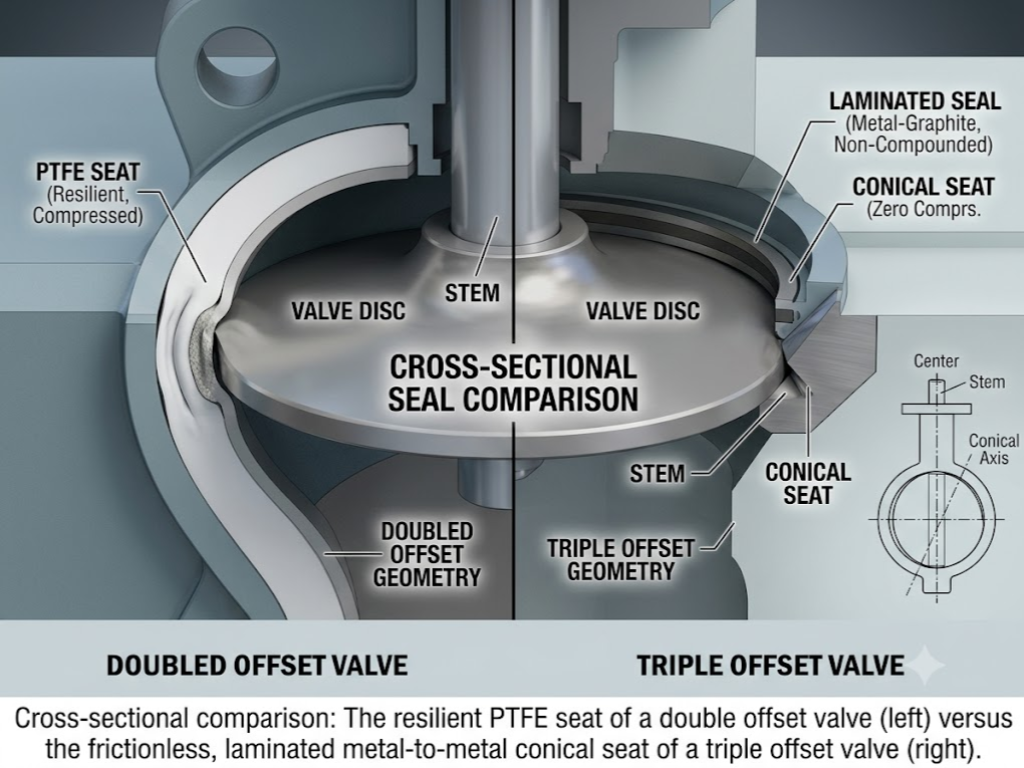
The seat in a double offset valve is typically a resilient material: PTFE, RPTFE (reinforced PTFE for better dimensional stability), or EPDM for water applications. Metal seat options exist but are not the standard configuration. Because the sealing still involves brief friction, the seat material sets the valve’s practical temperature ceiling: PTFE maxes out around 260°C for continuous service. Above that, the polymer softens, cold-flows under compression, and loses its ability to hold a seal.
Under API 609, double offset valves fall into Category B (high-performance), which means they use the longer face-to-face dimensions defined by ASME B16.10 for larger sizes and higher pressure classes. This dimensional difference matters if you are retrofitting a Category B valve will not drop into the same pipe gap as a Category A concentric valve of the same nominal size (API 609, Category A vs B distinction).
Double Offset Contact Window: ~10°
Triple Offset Contact Window: ~2–3°
Triple Offset Design The Conical Seat Geometry That Achieves True Zero-Leakage Metal-to-Metal Sealing
A triple offset valve adds the third offset: the seat is machined to a conical profile, typically with an 8° to 12° cone angle. The disc sealing surface matches this cone angle. The result is what valve engineers call “cone-in-cone” geometry the disc swings completely free of the seat through roughly 87° of its 90° stroke, making contact only at the final 2° to 3° of rotation.
That tiny contact window changes the physics of sealing. In a double offset valve, the seal comes from the disc compressing a soft seat. In a triple offset valve, the seal comes from torque the actuator drives the disc into the conical seat, and the metal-to-metal contact deforms just enough at the microscopic level to create a continuous sealing line. No soft components. No friction during travel. No wear mechanism beyond the final instant of closure.
The sealing ring is the critical component: it is a laminated stack of alternating stainless steel and graphite layers. The graphite provides conformability at the sealing face; the stainless steel provides structural integrity. This laminated construction is what allows triple offset valves to achieve ANSI/FCI 70-2 Class VI leakage bubble-tight, zero visible leakage with an all-metal seat. No soft seat in any valve type can match this combination of sealing tightness and temperature immunity.
And the temperature immunity is dramatic. While a PTFE-seated double offset valve is done by 260°C, a triple offset valve with a Stellite or Inconel hard-facing on the seat can operate continuously at 815°C. That is the difference between “good for process water and light steam” and “good for superheated steam main isolation and refinery hydrocarbon service.”
Double Offset vs Triple Offset Head-to-Head Performance Comparison
The table below gives you the numbers. The three paragraphs after it tell you what those numbers actually mean for your project.
| Dimension | Double Offset | Triple Offset | What It Means for Your Project |
| Sealing Mechanism | Cam-action, last ~10° wiping contact | Cone-in-cone, last ~2 3° frictionless | Dictates seat life and maximum cycle frequency |
| Standard Seat Material | Resilient (PTFE / RPTFE / EPDM) | Metal-to-metal (laminated SS + graphite) | Determines temperature ceiling and chemical compatibility |
| Maximum Temperature | ~260°C (resilient seat) / ~400°C (metal seat option) | Up to 815°C (Stellite / Inconel overlay) | The hard cut-off between “process general” and “severe service” |
| Maximum Pressure Class | Class 300 (PN40) typical | Class 900 (PN100) standard; Class 1500 in special designs | Above Class 300, double offset is not an option |
| Leakage Class (ANSI/FCI 70-2) | Class V (metal seat) / Class VI (soft seat) | Class VI (metal-to-metal, zero leakage) | For hazardous or toxic media, only Class VI with metal seat qualifies |
| Fire-Safe (API 607) | Requires combination metal + soft seat | Inherent (all-metal construction) | In oil and gas, no API 607 certificate = valve rejected at incoming inspection |
| Flow Direction | Bidirectional (preferred direction recommended) | Unidirectional (torque-seated; reverse flow sealing degrades at sizes above 24″) | Triple offset must follow the arrow on the body |
| Relative Purchase Cost | 2 4× concentric baseline | 5 10× concentric baseline | The number that determines whether your budget approves the spec |
Sealing: why metal-to-metal zero leakage changes the game. A double offset valve with a PTFE seat can achieve Class VI leakage while the seat is new. But PTFE cold-flows under sustained compression, which means the seal degrades over time even if the valve just sits closed. Triple offset valves use a laminated seal ring where the graphite layers conform at the microscopic level when torqued closed, then relax when opened. No compression set. No degradation from just sitting there. This is why process engineers in the chemical and refining industries treat triple offset as the default for any service where a leak would mean more than a damp floor.
Temperature: where the PTFE ceiling hits. PTFE melts at approximately 327°C, but its practical continuous-service limit is around 260°C above that, it softens progressively and loses the ability to rebound after each closure cycle. On engineering forums, field experience is blunt: one eng-tips.com contributor with three decades in valve maintenance reported replacing PTFE seats on double offset valves in 370°C steam service roughly every six months (eng-tips.com thread 145006). If your application runs above 300°C continuously, double offset is a recurring maintenance cost, not a one-time purchase.
Torque: the hidden actuator sizing trap. Triple offset valves theoretically need less running torque because there is no friction during travel. In practice, they are torque-seated the final seating torque that wedges the disc into the cone can be 1.5 to 2 times the running torque. If you size the actuator based on running torque alone, the valve will close but not seal. Actuator selection must use seating torque as the design case, with a safety factor of 1.3 to 1.5 above that. Engineers on CR4’s forum have flagged undersized actuators as the single most common commissioning failure for triple offset installations (CR4 thread 54691).
Common Commissioning Failure
Engineers on valve forums consistently report undersized actuators as the single most common commissioning failure for triple offset installations. Always size the actuator for seating torque × 1.5 safety factor not running torque.
Where Each Offset Type Belongs Application Mapping by Industry and Operating Condition
Most comparison articles list applications next to valve types without explaining why. The “why” always comes back to four parameters: media type, temperature range, pressure class, and leakage requirement. Change any one of these, and the correct offset type may flip.
Before the industry breakdowns below, use this quick self-check: if your pressure class is Class 600 or above, stop reading and specify triple offset. If your temperature exceeds 400°C, stop reading and specify triple offset. If neither applies, the sections below will guide you.
Water Treatment, Desalination, and General Utility Where Double Offset Is the Economic Sweet Spot
The typical water treatment or desalination butterfly valve sees clean or lightly contaminated water at ambient to moderate temperatures (0°C to 80°C), pressures under PN25, and bidirectional flow. For these conditions, double offset is not the compromise option it is the optimal one.
The reasoning is straightforward: seawater and treated water are not chemically aggressive to stainless steel (316 or 316L body material handles chloride corrosion adequately), the pressures are well within Class 150/300 limits, and the bidirectional sealing of a double offset valve with PTFE or RPTFE seats handles normal operating conditions without issue. On a chemical engineering forum, engineers evaluating 12-inch to 18-inch seawater filtration valves at 5 bar unanimously recommended double offset butterfly valves as the most economical and compact choice outperforming gate and ball valves on installed cost and maintenance access (CheResources thread 22507).
The temptation to “upgrade” to triple offset for seawater is common and usually unnecessary. Triple offset in a 5-bar, ambient-temperature seawater line is like buying a racing suspension for a commuter car the capability is real, but you will never use it, and the price premium earns zero return.
What does matter in water treatment is getting the material selection right. The most frequent failure mode in desalination butterfly valves is not the offset type it is chlorides attacking the wrong body material. If the valve body is standard carbon steel (WCB) without adequate corrosion allowance, or if the seat material is EPDM in a chlorinated water line, the valve fails regardless of offset geometry. This is where working with a manufacturer that performs a structured, multi-dimensional engineering analysis covering media chemistry, temperature range, pressure envelope, connection standards, actuation method, material compatibility, and industry-specific requirements prevents problems before they reach the purchase order. An engineering team with experience across 800-plus installed projects and a portfolio of over 20 seawater desalination references has seen enough real-world edge cases to flag compatibility issues that a catalog specification sheet would miss.
-
800+ Completed Projects (Across water, O&G, chemical, power)
-
20+ Desalination References
The detailed butterfly valve specifications and dimensional data that matter for water-treatment sizing face-to-face dimensions per API 609, ISO 5211 mounting patterns, and Center-to-Top measurements for automated assemblies are available in VINCER’s technical documentation.
Oil and Gas, Refineries, and Petrochemical Where Triple Offset Is Non-Negotiable
If your project involves hydrocarbons, the conversation shifts from “which valve is better” to “which valve is legal.” API 607 fire-safe certification is a hard requirement in virtually every oil and gas facility without it, the valve will be rejected at incoming material inspection regardless of its other merits. Triple offset valves with laminated stainless steel and graphite seals pass API 607 inherently because there is nothing combustible in the sealing system. Double offset valves can achieve API 607 compliance, but only with a specially engineered combination seat and not every manufacturer offers this configuration.
The second non-negotiable is chemical compatibility. Hydrocarbons especially aromatic compounds and sour gas streams containing hydrogen sulfide (H S) attack PTFE in ways that water and steam do not. PTFE absorbs hydrocarbons and swells. Over time, the dimensional change compromises the sealing geometry. For sour service, you also need compliance with NACE MR0175 / ISO 15156 for materials resistant to sulfide stress cracking and the valve body, trim, and bolting must all meet the standard.
The third factor is leakage consequence. In a water treatment plant, a Class V leak means a puddle on the floor. In a refinery, a Class V leak on a hydrocarbon line means a vapor cloud that triggers a safety shutdown or worse. Zero-leakage Class VI metal-to-metal sealing is not a premium feature in this context. It is the minimum acceptable performance level, and double offset valves in metal-seat configuration (Class V) do not meet it.
On eng-tips.com, engineers who write EPC specifications for oil and gas projects describe a clear hierarchy: concentric butterfly valves are permitted for water and utility services only, double offset for general process fluids up to Class 300, and triple offset mandatory for any service involving H S, high-temperature hydrocarbons, or safety-critical isolation (eng-tips.com thread 389220).
API 607 = Non-Negotiable for Oil & Gas
Without a per-model API 607 fire-test certificate, your valve will be rejected at incoming inspection regardless of other merits. Triple offset valves with laminated metal-graphite seals pass inherently.
Steam, Power Generation, and High-Temperature Service The Thermal Expansion Test
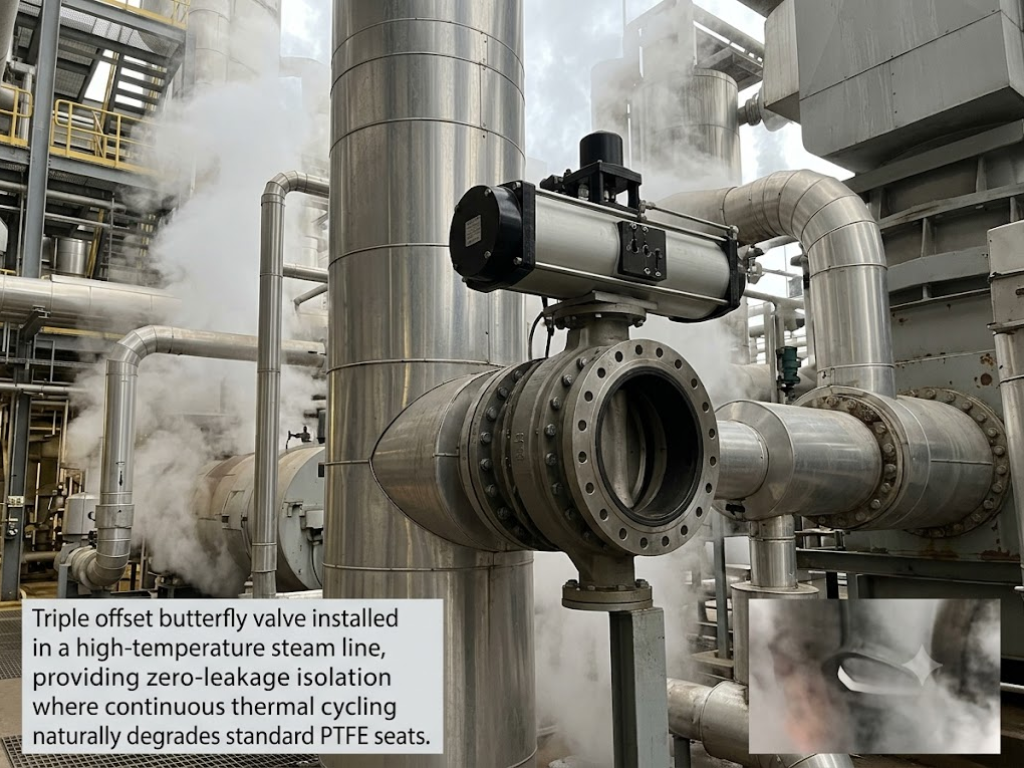
High-temperature steam exposes the fundamental weakness of double offset geometry. As temperature rises, the stainless steel disc expands. In a double offset valve, that expansion pushes the disc edge harder against the PTFE seat increasing friction, accelerating wear, and progressively deforming the polymer. The failure mode is gradual: sealing performance degrades over weeks or months, until a scheduled shutdown reveals a seat that needs replacement.
Above 300°C, the problem compounds. PTFE loses mechanical strength progressively as it approaches its melting point, and the repeated thermal cycling of steam systems heating up from cold to 350°C and cooling back down works the material harder than steady-state operation at any single temperature. Field experience is unambiguous: double offset valves in steam service above 350°C consume seats at a rate that makes the lower purchase price irrelevant within two years of operation.
A triple offset valve solves this by removing the polymer from the equation entirely. The laminated stainless steel and graphite seal ring has no temperature limit within the practical range of industrial steam (even superheated steam at 550°C is well within capability). And because the disc does not rub the seat during travel, thermal expansion does not create additional friction the disc simply wedges into the cone at closure, regardless of its expanded dimensions (bcstvalve.com technical article).
For power generation applications, the decision rule is simple: if your steam temperature exceeds 300°C, double offset should not be on the table. The engineering team at your valve supplier should be able to show you the seat material’s continuous-service temperature rating and explain how it accounts for thermal cycling not just the steady-state number.
Temperature Capability Comparison
-
PTFE Seat (Double Offset): 260°C
-
Metal Seat (Double Offset): 400°C
-
Metal Seat (Triple Offset): 815°C
Chemical Processing, Cryogenics, and Extreme Media Material Compatibility Decides
In chemical and cryogenic services, the offset type decision is secondary to the material compatibility decision but the two are linked because your offset type determines which materials are available.
For aggressive chemicals (strong acids, chlorinated solvents, oxidizing media), a PTFE- or PFA-lined double offset valve is often the correct answer. The lining provides a continuous corrosion barrier that no metal not even Hastelloy can match for certain chemical combinations, and the double offset geometry keeps the lining intact by minimizing the wiping contact that would abrade a soft liner. For cryogenic services like LNG at -162°C, the equation flips: you need an all-metal triple offset valve with an extended bonnet that moves the stem packing far enough from the cold zone to stay above freezing. Austenitic stainless steel (304L or 316L) is required; carbon steel becomes brittle at LNG temperatures.
For slurries and media containing abrasive solids, triple offset is the clear winner for one simple reason: there is no soft seat for particles to embed into. In a double offset valve handling a slurry, solid particles become trapped in the PTFE seat surface on every closure, creating permanent leak paths. The metal seat of a triple offset valve sheds particles on opening because there is no soft matrix to capture them.
What No One Tells You About Cost The Real Price Gap and Total Cost of Ownership
Most comparison articles acknowledge that triple offset costs more than double offset, then change the subject. Here is the actual framework you need to make a budget decision.
For a typical DN150 (6-inch) Class 150 butterfly valve, the approximate purchase price ratios are: concentric baseline = 1×, double offset = 2× to 3×, triple offset = 5× to 8×. These are ratios, not quotes absolute prices vary by manufacturer, material grade, and order quantity but the multipliers hold across the market.
What the purchase price does not capture is total cost of ownership. Consider a double offset valve in a high-cycle steam application at 320°C. The PTFE seat needs replacement every 12 to 18 months. Each replacement costs the seat itself, plus labor, plus system downtime. Over five years, that is three to four seat replacements. Now compare a triple offset valve at the same size and class: purchase price is roughly 3× higher, but the laminated metal-graphite seat lasts the full five years often ten or more with zero maintenance interventions. In high-cycle or elevated-temperature service, the triple offset valve’s five-year TCO can be lower than double offset, despite the higher upfront investment.
Cost Overview
-
Purchase Price: 2–3× (Double Offset) Lower upfront investment. Ideal for moderate conditions where the premium of triple offset earns no return.
-
5-Year TCO (High-Cycle Steam): Lower (Triple Offset) Despite 3× higher purchase price, zero seat replacements over 5 years make total cost lower than double offset in demanding service.
The counterpoint, equally true and too often omitted, comes from the engineering community itself: triple offset valves are over-specified in approximately half of all installations. A veteran engineer on eng-tips.com with over 30 years in the valve industry put it plainly: “Triple offset is for when you absolutely cannot have a leak or when temperatures are extreme. For everything else, double offset does the job at a fraction of the cost.” If your application runs clean water at ambient temperature under Class 150, paying 5× to 8× for triple offset is not engineering it is anxiety spending.
One structural reason cost varies so dramatically by sourcing origin is supply chain efficiency. Manufacturers with integrated production in-house CNC machining, their own assembly lines, and direct relationships with foundries avoid the multi-tier markup that inflates Western-brand pricing for the same casting grades and material specifications. A 7,200-square-meter facility running four dedicated production lines with a 45-person workforce can produce small-to-medium batch orders with lead times of 7 to 10 working days for standard configurations and approximately 15 to 30 days for custom-engineered valves roughly one-third the typical lead time of a Western manufacturer for a comparable specification. That speed difference itself carries a cost: shorter lead times mean less working capital tied up in inventory and fewer project delays. An engineering team with a track record across more than 800 completed projects can typically provide an initial solution proposal within 24 hours for straightforward applications and a comprehensive multi-product project proposal within 48 hours, so you are not waiting weeks just to know whether the supplier can meet your spec.
If you are evaluating suppliers, look for the combination of detailed technical specifications and dimensional data that let you verify face-to-face, actuator mounting, and material compatibility before you issue a purchase order because correcting a spec mismatch after delivery costs far more than getting it right upfront.
How to Decide A 3-Question Selection Framework
The framework below distills everything covered in this article into three questions. Answer them in order, and you will know which offset type your application needs.
The 3-Question Decision Flow Answer These and You Will Know
Question 1: What are your operating temperature and pressure?
If your temperature exceeds 400°C or your pressure class is Class 600 or above, the decision is made specify triple offset. Double offset valves do not exist in Class 600; at temperatures above 400°C, PTFE-based seats are not viable. If your conditions are below both thresholds, proceed to Question 2.
Question 2: What is your process media?
If it is a hydrocarbon (crude oil, refined products, natural gas, H S-containing streams), a hazardous chemical, or a slurry containing abrasive solids, specify triple offset. Hydrocarbons chemically attack PTFE seats; hazardous chemicals demand the leakage integrity of metal-to-metal Class VI sealing; abrasive solids embed in soft seats and create permanent leak paths. If your media is clean water, treated wastewater, light chemicals compatible with PTFE or RPTFE, or non-hazardous gases, proceed to Question 3.
Question 3: What are your leakage requirements and industry code obligations?
If your project specification requires API 607 fire-safe certification, ANSI/FCI 70-2 Class VI zero-leakage performance, or a Safety Integrity Level (SIL) rating for critical isolation, specify triple offset. These are regulatory gateways you either meet them or your valve is rejected. If your leakage requirement is Class V or below and no fire-safe or SIL certification is specified, double offset is the better value it meets the technical requirement at substantially lower cost.
Common Pitfalls and Red Flags When NOT to Follow the “Obvious” Choice
-
Reverse Flow Leakage: Triple offset >24″ leaks backward. Always verify flow direction arrow.
-
Actuator Undersizing: Size for seating torque × 1.5 safety factor, not running torque.
-
Face-to-Face Mismatch: API 609 Category A & B dimensions. Verify before ordering a replacement.
-
Fake Triple Offset: Demand API 609 Cat B report, API 607 cert, and MTC per EN 10204 3.1.
Sourcing Double and Triple Offset Valves from China A Practical Verification Checklist
China is the world’s largest exporter of industrial valves, and the gap between the best and the average is wide. A well-engineered Chinese triple offset valve built in a facility with CNC machining centers, in-house testing rigs, and an experienced engineering team performs on par with Western-brand equivalents at 30% to 50% lower cost. A poorly made one fails within months. The difference is not visible in a product photo.
Here is a five-point verification checklist you can use regardless of which manufacturer you are evaluating:
-
API 609 Category B test report: Verify the category designation specifically, not just “API 609 compliance.”
-
API 607 fire-test certificate (per model): Generic company certification is not sufficient.
-
ISO 9001:2015: Verify scope covers valve design and manufacturing, not just trading.
-
MTC per EN 10204 3.1: For all pressure-containing components: body, disc, stem, seat ring.
-
Pre-shipment seat test: Video or signed report per ANSI/FCI 70-2 Class VI criteria.
A manufacturer worth trusting will have certifications that are publicly verifiable ISO 9001, CE, and functional safety certifications such as SIL backed by an engineering team of a decade or more of project experience, not just a sales office. Their full certification portfolio should be accessible for review before you commit to an order, and their technical team should be capable of walking through your application requirements across multiple dimensions media, temperature, pressure, connection standards, actuation method, material compatibility, and industry-specific regulations before recommending a configuration.
A final thought: the choice between double offset and triple offset is not about which valve is “better.” It is about which valve matches your actual operating conditions at the lowest total cost of ownership. Answer the three questions, verify what you are buying, and let your application not a feature table or a sales pitch drive the decision. VINCER’s engineering team, with certifications including ISO 9001:2015, CE, RoHS, SIL, and FDA, and project experience spanning over 800 installations across water treatment, oil and gas, chemical processing, and power generation, is available to support technical evaluations at www.vincervalve.com.
References
-
Project Materials Blog. “Butterfly Valve Offset Types Concentric, Double Offset, Triple Offset.” 2024.
-
Eng-Tips Forums. “Butterfly valve design: conc, ecc, double ecc or triple eccentric?” Thread 145006.
-
Eng-Tips Forums. “Triple offset butterfly valve.” Thread 389220.
-
Eng-Tips Forums. “Triple off-set butterfly valve sealing in reverse direction.” Thread 435592.
-
CR4 GlobalSpec Engineering Forum. “Triple Offset Butterfly Valve.” Thread 54691.
-
CheResources Engineering Forum. “Ball Vs. Gate Vs. Butterfly Valves.” Thread 22507.
-
BCST Valve. “Where a Triple Offset is the Only Real Solution.”
-
VINCER Valve. “Butterfly Valve Technical Specifications and Dimensional Data.”
-
VINCER Valve. “Certifications.”
-
VINCER Valve. “About Us.”
-
VINCER Valve. Homepage.
 English
  French
  Spanish
  Italian
  German
  Dutch
Dutch  Portuguese
  Korean
  Russian
  Chinese
  Finnish