
If you’re sourcing electric actuated butterfly valves for a desalination plant, food processing line, oil and gas facility, or equipment integration project, you already know the core challenge: the manufacturer landscape is fragmented. One search returns dozens of suppliers, but distinguishing a reliable long-term partner from a one-off vendor takes more than comparing spec sheets. The right manufacturer for a project contractor managing a $5M water treatment facility is rarely the right one for an equipment OEM integrating valves into a compact machine, or a distributor stocking SKUs across three continents.
This guide maps the electric actuated butterfly valve manufacturing landscape by buyer profile so you can shortlist the suppliers that match your specific procurement role, not the ones with the best SEO.
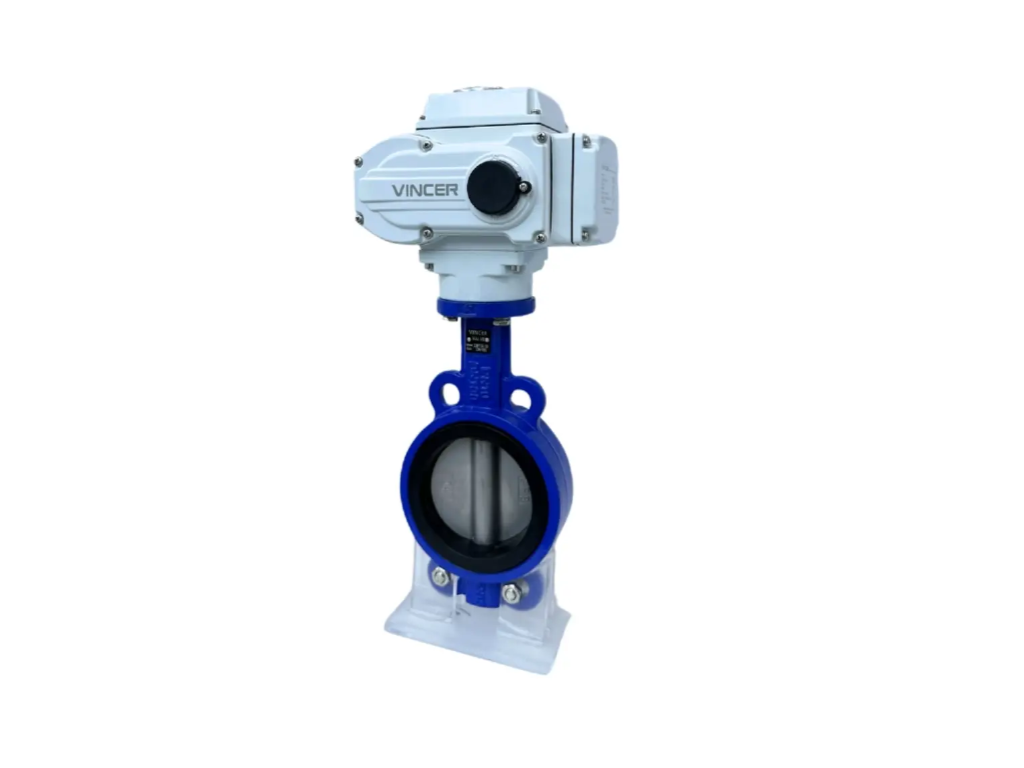
What Defines an Electric Actuated Butterfly Valve
An electric actuated butterfly valve pairs a quarter-turn butterfly valve with an electric motor-driven actuator. The actuator rotates the valve disc 90 degrees from fully closed to fully open using an electric signal rather than manual force or compressed air. This makes it the default choice for automated pipelines where pneumatic infrastructure is unavailable or where precise positioning and remote control are required.
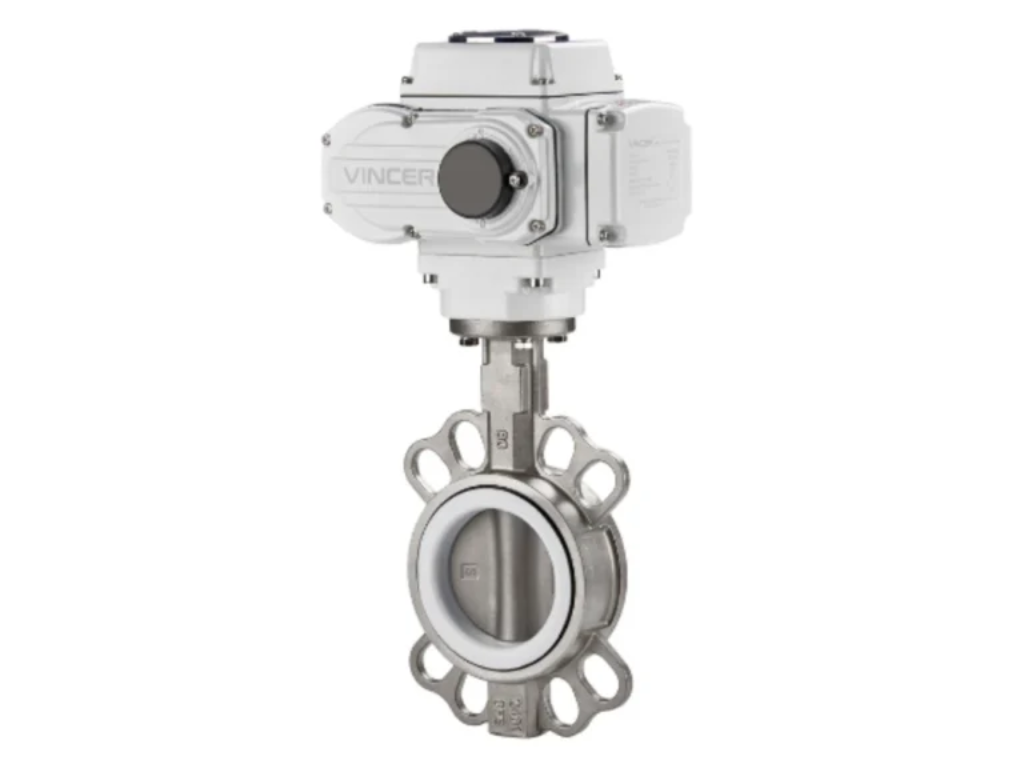
Structurally, the valve side comes in three connection types. Wafer-style valves sandwich between two pipe flanges and suit general-purpose lines up to DN 300 where weight and cost matter. Lug-style valves add threaded inserts that allow dead-end service you can disconnect downstream piping without shutting off the entire line. Flanged valves bring integral flanges for larger diameters (DN 300+) and higher-pressure systems where stability is non-negotiable.
The sealing mechanism falls into three eccentricity grades, which determine how much pressure and temperature the valve can handle. A concentric (zero-offset) design keeps the stem centered through the disc and seat the seal rubs through the entire stroke, which is fine for low-pressure water and air below 200°C but wears faster under cycling. A double-offset design cams the disc away from the seat immediately after opening, reducing friction and extending seat life into medium-pressure steam and chemical service. A triple-offset design adds a third geometry layer that creates a metal-to-metal seal zero leakage at pressures up to 1,500 psi and temperatures up to 450°C, making it the standard for critical service in oil and gas, refining, and power generation.
Eccentricity Grade Overview:
-
Concentric: < 200°C | Low pressure · PN10 16 | Water, air, general utility. Full-stroke seal contact wears faster under cycling.
-
Double-Offset: -29°C to +200°C | Medium pressure · PN16 40 | Steam, chemical processing. Disc cams away from seat less friction, longer seat life.
-
Triple-Offset: -196°C to +450°C | High pressure · up to PN100 | Oil & gas, refining, power. Metal-to-metal seal zero leakage at 1,500 psi.
These structural differences are the reason two manufacturers quoting a “DN200 electric butterfly valve” can be $400 apart. The valve body type, offset grade, and actuator control mode each multiply the cost and the application risk if chosen wrong.
Top Manufacturers Compared by Buyer Profile
Your procurement role dictates which manufacturer attributes actually matter. A project contractor evaluating valves for a municipal water plant weights certifications and global service reach differently than an equipment OEM who needs a valve that fits inside a 300mm machine cavity and ships with full 2D/3D drawings in under two weeks.
Here is how the global manufacturer landscape breaks down by buyer type, using real company data.
For Project Contractors Emerson, Bray, and KSB
Project contractors represent roughly 60-70% of electric butterfly valve procurement volume. The stakes are high a valve failure on a commissioned plant triggers downtime costs that dwarf the valve purchase price. Three manufacturers dominate this segment.
| Manufacturer | Core Strength | Watch For |
| Emerson (Keystone) | API 609 + PED + ATEX + SIL certified; service network in 150+ countries; invented the modern butterfly valve | Premium pricing (3-5x Chinese equivalents); custom builds ship in 12-16 weeks |
| Bray International | Dedicated butterfly specialist; modular electric actuation (Series 30/31 + McCannalok HP); ISO 5211 standard mounting | Smaller global footprint than Emerson; fewer severe-service certified products |
| KSB Group | 150+ years German engineering; large-diameter DN 1000mm+ valves; manufactures own actuators for complete packages | EU-centric support; weaker Asia-Pacific coverage |
Emerson is the safest choice when the project spec demands a full certification stack and the budget supports it. Bray brings more focused butterfly expertise with shorter lead times (8-12 weeks typical). KSB dominates large-diameter water infrastructure where its in-house actuator manufacturing removes a potential integration liability.
Key Insight: Emerson is the safest bet when certifications are non-negotiable. Bray delivers better lead times at lower cost for less regulated projects. For budget-constrained contractors, a Chinese manufacturer with ISO/CE/SIL/FDA certifications fills the middle tier trading on-site service breadth for speed and price.
For project contractors working with tighter budgets or shorter timelines, manufacturers based in China with strong certification portfolios offer a middle path. As a Dongguan-based manufacturer with ISO 9001, CE, RoHS, SIL, and FDA certifications, VINCER Valve provides an 8-dimension selection methodology covering media type, temperature, pressure, connection standard, control mode, material requirements, industry characteristics, and applicable standards that helps project teams avoid the most common specification error: ordering a valve that meets the pressure rating but fails on material compatibility. VINCER’s standard lead time of 7-10 working days (30 days for custom builds) runs roughly two to three times faster than Western manufacturers, though its global on-site service network is naturally narrower than Emerson’s.
For Equipment OEMs AUMA, Tomoe, and RIFT Actuators
Equipment OEMs companies integrating valves into their own machines and systems account for roughly 20% of electric butterfly valve demand. The evaluation criteria shift. Instead of asking “does this valve have every certification known to engineering,” the right questions become: can it fit into my equipment, can I get the drawings I need today, and will the unit cost keep my machine competitive.
| Manufacturer | Core Strength | Watch For |
| AUMA | 60+ years actuator-only expertise; 10-4,000 Nm torque range; ISO 5211 mounting across all models; 30 global locations, 2,800 staff | Does not manufacture valve bodies actuator + valve pairing depends on partners |
| Tomoe Valve | Japanese butterfly specialist since 1953; compact designs suited for equipment cavities; UK-based actuation center for fast custom delivery | Narrower product line than Emerson/Bray; limited US presence |
| RIFT Actuators | UK smart actuators (0-2,000 Nm) with real-time valve health analytics via mobile/tablet; IIoT-ready; bespoke configurations | Young company (est. 2011); limited global distribution network |
AUMA is the Bosch of the segment it doesn’t make the whole valve, but its actuators are the standard that valve body manufacturers design around. Tomoe offers the tightest vertical integration for compact applications, particularly marine and process equipment. RIFT is the outlier for OEMs building next-generation smart equipment its health analytics differentiate it from traditional actuator manufacturers, though its distribution is still maturing.
Equipment OEM Stats:
-
10-4,000: Nm Torque Range
-
30-50%: Lower vs. Western
-
7-10d: Standard Lead Time
For equipment OEMs, the ability to provide 2D and 3D technical drawings on request and to customize actuator coils for lower current draw can be decisive. VINCER maintains an extensive library of pre-built CAD drawings for its 12 product series and can produce new drawings in coordination with its factory. For OEMs with minimum order quantities of 300+ units, coil modification to reduce system current consumption is available a capability that addresses the “energy budget” concern common in multi-valve equipment designs. Pricing, compared to Western actuator benchmarks, is typically 30-50% lower at equivalent performance, though OEMs should verify that any required explosion-proof certifications (ATEX Zone 1/2) are confirmed at the RFQ stage rather than assumed.
For Distributors AVK Group and DeZURIK
Distributors evaluate manufacturers on a different axis: brand recognition in the territory, breadth of product line, and the quality of sales enablement technical training, marketing collateral, sample support, and competitive market data.
| Manufacturer | Core Strength | Watch For |
| AVK Group | Danish brand; dominant in water/wastewater with AWWA + WRAS + ACS certifications; mature distribution across Europe, Middle East, Africa | Industry focus is narrow nearly all water; limited relevance for oil and gas, chemical, or food distributors |
| DeZURIK | US brand; BHP high-performance + AWWA butterfly lines; strong in water, wastewater, pulp and paper; comprehensive dealer training and technical documentation | Limited Asia-Pacific and Middle East dealer network |
AVK and DeZURIK are natural fits for water-sector distributors who can build a regional business around a single well-recognized brand. Their limitation is breadth a distributor serving multiple industries will need to carry additional brands to cover chemical, food processing, or HVAC applications, which increases procurement complexity.
A manufacturer with a broader product range reduces the number of supplier relationships a distributor has to manage. VINCER’s catalog spans 12 major product series with approximately 20 sub-categories of automated valves covering everything from electric and pneumatic actuators to ball, butterfly, gate, globe, control, and solenoid valves. For a distributor building a catalog for Southeast Asian or Middle Eastern markets, this means one supplier relationship can cover most automated valve demand, with technical support, promotional materials, sample availability, and market data analysis provided as standard dealer support (VINCER internal dealer program, 2025).
Critical Specifications and Certification Requirements
Certificates are the first screen in manufacturer evaluation but reading them correctly is a skill most sourcing teams learn the hard way.
The core certification stack for electric actuated butterfly valves includes six standards worth understanding individually:
-
ISO 9001: a quality management system certification. It verifies process consistency not product performance.
-
CE marking: required for EU market access. Note that many valves carry a manufacturer’s self-declaration of conformity rather than a notified-body audited certificate. The two are not equivalent.
-
SIL (Safety Integrity Level): rated 1-4. Butterfly valves in safety instrumented systems typically need SIL 2 or SIL 3.
-
ATEX: the explosion-proof standard for hazardous environments. It identifies Zone 0/1/2 for gas or Zone 20/21/22 for dust.
-
API 609: the definitive butterfly valve design standard. Category A covers soft-seated valves rated -29°C to +200°C. Category B covers metal-seated valves spanning -196°C to +816°C.
-
FDA: food-contact compliance required for any valve handling edible products or pharmaceutical ingredients.
⚠️ Certification Traps to Avoid:
-
CE Self-Declaration Trap: A CE mark on a valve data sheet is often a self-declaration, not an independent certification. Ask for the notified body number (a four-digit code) to verify.
-
ISO 9001 ≠ Product Testing: ISO 9001 certifies that a factory follows documented procedures; it does not test the valves those procedures produce. A manufacturer with ISO 9001 and no material test certificates is less credible than one without ISO 9001 that provides full MTCs.
The three documents that reveal actual quality more reliably than any certificate are: a Material Test Certificate (MTC) covering both raw material and finished product, a sealing test video showing the valve under pressure before shipment, and a pre-shipment inspection photo set documenting every valve against the order specification. Manufacturers that provide all three unprompted are signaling a quality culture; those that push back when asked are signaling something else.
Document Checklist:
-
Material Test Certificate (MTC): Covers both raw material and finished product verifies what the valve is actually made of.
-
Sealing Test Video: Shows the valve under pressure before shipment proves it doesn’t leak when it matters.
-
Pre-Shipment Inspection Photos: Documents every valve against the order specification catches discrepancies before they ship.
Relevant test and design standards to reference in your specification: MSS SP-67 (butterfly valve dimensional standard), API 598 (seat leakage testing), and ISO 5208 (industrial valve pressure testing) (American Petroleum Institute, 2023; International Organization for Standardization, 2022).
Sourcing from China vs. Western Manufacturers A Realistic Comparison
Every procurement engineer evaluating electric actuated butterfly valve manufacturers faces this calculus and the existing content landscape offers almost no structured help in making it. The comparison below is not about “which is better.” It is about which trade-offs your specific project can tolerate.
| Dimension | Western Manufacturers (Typical) | China-Based Manufacturers (Typical) | How to Verify |
| Price DN100 PN16 valve | $800-2,500 | $300-800 | Request 3 quotes with identical spec sheet |
| Lead time standard | 8-12 weeks | 1-2 weeks | Ask for current production schedule, not a website claim |
| Lead time custom | 12-16 weeks | 4 weeks | Confirm whether “custom” means modified stock or new casting |
| Certifications | API/ATEX/PED typically standard | CE+SIL+ISO common; API/ATEX less frequent | Ask for certificate numbers and verify on issuing body’s database |
| Technical response | Standardized process, slower turnaround | Flexible, often same-day drawing modifications | Send a test RFQ with a non-standard dimension and measure reply time |
| After-sales support | Local service network in major markets | Remote diagnosis + free replacement parts; on-site limited | Ask for the location of the nearest field service engineer |
Price Split Comparison (DN100 PN16 · typical quote):
-
Western Manufacturers: $800-2,500
-
China-Based Manufacturers: $300-800
For a DN100 PN16 electric actuated butterfly valve, Western manufacturers typically quote $800-2,500 depending on brand and actuation type, while Chinese manufacturers range from $300-800 (industry pricing benchmarks, 2025). The gap narrows on highly customized or exotic-material valves, where Western manufacturers’ material sourcing advantages offset some labor cost differences. Ocean freight from China to the Middle East adds roughly 20-25 days; to Europe, 30-35 days factor this into total project timelines.
The decision framework is pragmatic: choose Western when your project has non-negotiable API 6D or ATEX requirements and on-site after-sales support is contractually required. Consider Chinese manufacturers when budget sensitivity is high, lead time is constrained, or you need a single supplier to cover multiple valve types electric butterfly valves plus manual gate valves, pneumatic ball valves, and solenoid valves as part of a one-stop procurement strategy. In practice, many project contractors maintain both types of suppliers in their approved vendor lists and route RFQs based on project tier.
The gap between top-tier Chinese manufacturers and Western benchmarks has narrowed significantly over the past five years. A Chinese manufacturer with ISO 9001, CE, RoHS, SIL, and FDA certifications, 14+ years of documented project experience across desalination, food processing, chemical, and oil and gas industries, and a 10+ person engineering team averaging a decade of experience per engineer such as VINCER Valve operates in a different tier from the “no-cert, no-drawings, fastest-quote-wins” stereotype. Its 24-hour simple quotation turnaround and 48-hour multi-product project proposal cycle is a useful efficiency benchmark when evaluating any manufacturer, regardless of country. For buyers whose project profile matches the equipment OEM or project contractor segments described above, VINCER’s documented deployments with Festo, Tameson, and Veolia provide a reference point for evaluating what a capable Chinese supplier delivers in practice (VINCER client case records, 2025).
How to Shortlist the Right Manufacturer for Your Next Project
Everything above leads to a four-step process you can run this week.
Step 1: Define your buyer profile. Are you buying for a project (certifications, service network, project references matter most), equipment integration (space constraints, drawing availability, unit cost matter most), or distribution (brand recognition, product breadth, dealer support matter most)? Your profile sets the evaluation weights for every criterion that follows.
Step 2: List your non-negotiable certifications. Separate the must-haves from the nice-to-haves. If your project operates in an ATEX Zone 1 environment, that eliminates roughly 95% of Chinese manufacturers immediately which narrows your shortlist productively. If your project only needs CE and ISO 9001 compliance, your viable supplier pool expands dramatically and price competition becomes a useful filter.
(Filter Tags: Restrictive: ATEX, API 609 | Common: ISO 9001, CE, SIL, FDA)
Step 3: Request three quotes with the same specification sheet. A proper RFQ spec sheet for an electric actuated butterfly valve includes eight fields: nominal diameter (DN), nominal pressure (PN), fluid medium, operating temperature, differential pressure, connection standard (ANSI/JIS/DIN/GB), control mode (on-off or modulating), and body/disc/seat material requirements. Send this exact sheet to at least three manufacturers. The response speed itself is a proxy metric 24 hours for a simple quotation and 48 hours for a multi-product project proposal indicate an organized internal process (VINCER Valve quotation benchmarks, 2025).
Step 4: Verify beyond the brochure. Request the material test certificate, a sealing test video, and photos of a similar past project’s pre-shipment inspection. These three artifacts tell you more about a manufacturer’s actual quality control than any sales presentation. If a manufacturer hesitates on any of the three, treat that hesitation as a data point in your evaluation.
The manufacturer that wins your business is not necessarily the cheapest or the biggest. It is the one whose capabilities align with what your specific buyer profile actually needs and who can prove it with documentation, not just a catalog.
References
-
American Petroleum Institute. “API 609: Butterfly Valves Double-flanged, Lug- and Wafer-type.” 2023.
-
International Organization for Standardization. “ISO 5208: Industrial Valves Pressure Testing of Metallic Valves.” 2022.
-
International Organization for Standardization. “ISO 5211: Industrial Valves Part-turn Actuator Attachments.” 2020.
-
VINCER Valve. “Client Case Records: Festo, Tameson, Veolia.” Internal documentation, 2025.
-
VINCER Valve. “Quotation and Service Benchmarks.” 2025.
 English
  French
  Spanish
  Italian
  German
  Dutch
Dutch  Portuguese
  Korean
  Russian
  Chinese
  Finnish