
Every year, procurement teams across Southeast Asia, the Middle East, and Europe evaluate dozens of pneumatic butterfly valve manufacturers. Some send RFQs to 20 factories and compare spreadsheets of FOB prices. Most end up confused — because the real question isn’t “who makes this valve.” It’s “who makes it for someone like me.”
A project contractor sourcing valves for a Saudi desalination plant needs fundamentally different things from a distributor stocking inventory for HVAC contractors in Dubai. Yet most sourcing guides treat all buyers as the same person. This article takes a different approach: we’ll segment manufacturers by buyer type, anchor each recommendation in real company data, and give you a verifiable framework for building a shortlist — whether you’re an EPC project manager, a valve distributor, or a bulk procurement buyer.
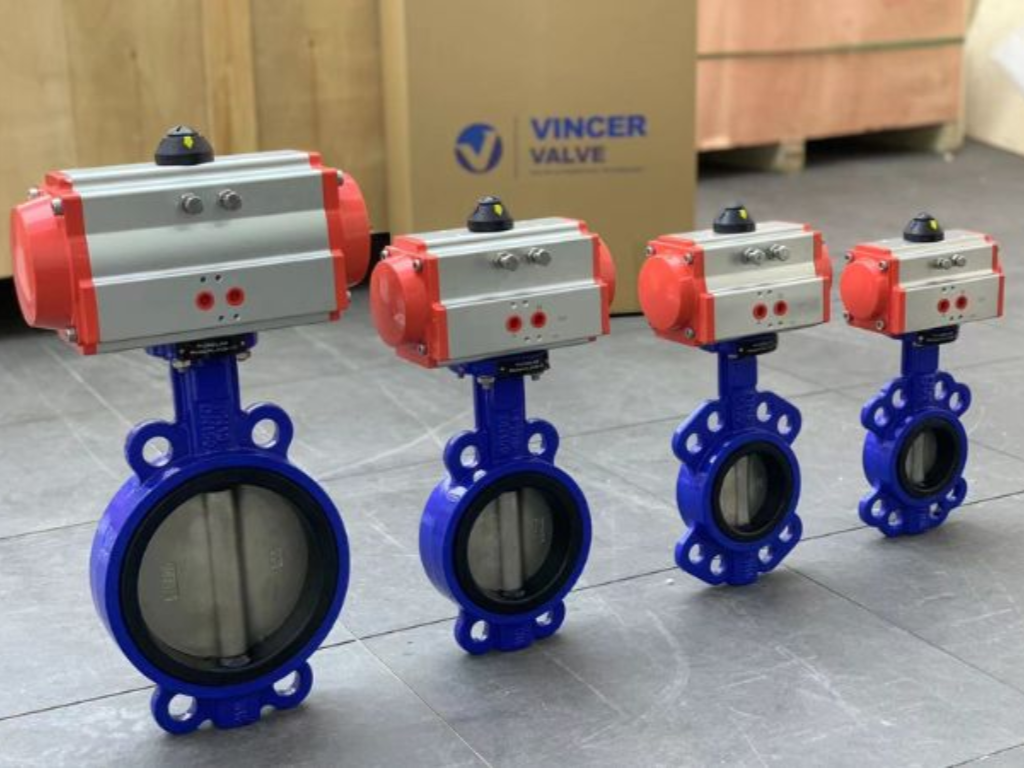
Why the “Pneumatic” Part Matters More Than You Think
In the control room of a seawater desalination facility, an operator presses a button. Two seconds later, a pneumatic butterfly valve completes a 90-degree rotation, isolating a reverse osmosis membrane bank. Why pneumatic and not electric? Because the valve sits in a humid, potentially corrosive environment where electrical actuators would need expensive explosion-proof or waterproof housings — and because a spring-return pneumatic actuator will automatically close the valve if air supply fails, protecting millions of dollars in membrane assets.
This is the core truth about pneumatic butterfly valves: they are not a commodity. The actuator and the valve body must be matched as a system. Three decisions define the system:
-
Actuator type: Double-acting (air-to-air, stays in position on air loss) versus spring-return (fail-safe, returns to open or closed on air loss). The choice depends on whether your process can tolerate a valve staying in its last position during a plant shutdown.
-
Valve connection: Wafer (sandwiched between flanges, lowest cost), lug (threaded inserts for dead-end service), or flanged (full flange, highest structural integrity). The choice depends on whether you need to disconnect one side of the pipeline while the other remains pressurized.
-
Seat material: EPDM (−20°C to 120°C, general water service), PTFE (up to 180°C, chemical resistance), or Viton (up to 200°C, hydrocarbon service). Getting this wrong means the valve leaks within months — not years.
A pneumatic butterfly valve is a system, not a part. The actuator, valve body, and seat material must be specified as a matched assembly — selecting any component independently creates compatibility risk that no datasheet can predict.
All pneumatic actuators should mount via ISO 5211 standard flanges, ensuring interchangeability between actuator brands. The compressed air supply should meet ISO 8573-1 Class 5.4.3 as a minimum — unfiltered plant air can corrode actuator internals (ISO 8573-1, 2010).
Understanding these fundamentals gets you to the starting line. The real challenge begins now: finding a manufacturer whose business model matches yours.
Choosing the Right Manufacturer for Your Business Model
Here’s a truth that most sourcing guides miss: global pneumatic butterfly valve manufacturers fall into two categories — engineering-grade suppliers built for project contractors, and trade-grade suppliers built for distributors and wholesalers. Choosing the wrong category is more expensive than choosing the wrong brand within the right category.
Before we dive into specific manufacturers, here is the buyer-type decision matrix that anchors everything that follows:
| Decision Dimension | Project Contractor Perspective | Distributor/Wholesaler Perspective |
| Most Values | Certification completeness, engineering support, past project track record | Lead time stability, margin structure, brand portability |
| Price Sensitivity | Medium (valves = 3–5% of project budget) | High (gross margin is the core KPI) |
| Technical Support Need | Deep (proposal design, 2D/3D drawings, site commissioning) | Moderate (product documentation, spare parts, warranty) |
| Typical Order Pattern | Project-based (50–500 units, one-time) | Recurring (monthly/quarterly reorders) |
| Lead Time Tolerance | 8–16 weeks is acceptable | 2–6 weeks expected |
| Brand Requirement | Specified by engineering consultant | Marketable, recognizable, or white-label capable |
Engineering-Grade
-
Deep certification stack (API, ATEX, SIL)
-
Full engineering support (2D/3D drawings, commissioning)
-
8–16 week lead times, project-based pricing
Trade-Grade
-
Fast lead times (2–6 weeks), predictable supply
-
Competitive margins (25–40% after freight)
-
Brand portability or white-label capability
For Project Contractors — Certification Depth, Engineering Support, and Where They Actually Manufacture
Project contractors live in a world where a single valve specification error can trigger a chain of liability — from the engineering consultant who wrote the spec, to the EPC who procured the valve, to the plant owner who operates it. The safest choice is the one nobody will be blamed for.
If your project is in oil, gas, or petrochemicals, Emerson’s Fisher and Keystone brands (Emerson) are the default. Their API 6D, ATEX, and SIL 3 certification coverage is the broadest in the industry, and their global service network means a replacement actuator can reach a Nigerian gas plant or a North Sea platform within days. The trade-off is price: a DN100 PN16 stainless steel pneumatic butterfly valve from Emerson runs $200–500 FOB, and lead times of 12–16 weeks are standard (Emerson — pneumatic butterfly valve product range and certification coverage, QY Research Global Automated Butterfly Valves Market Report, 2025).
If your project is in water treatment or municipal infrastructure, the more precise choices are KSB and Bray International. KSB’s BOAX-B series (KSB) scales to DN 1000 and carries DVGW, ACS, and WRAS drinking-water approvals — certifications that Emerson doesn’t prioritize because water isn’t their core market. Bray International (Bray), headquartered in Houston, is one of the world’s largest rotary valve manufacturers by volume, with resilient-seated butterfly valves deployed across thousands of water treatment plants globally. Bray’s advantage is cost-effectiveness within the engineering tier — typically 30–40% less than Emerson for water-grade specifications (Bray International — company profile and product range, Crunchbase, 2025).
If your project is in Asia-Pacific and requires JIS compliance, Kitz Corporation (Kitz) is the natural fit. Kitz butterfly valves support 250:1 turndown capability and carry full JIS certification — relevant for Japanese-funded infrastructure projects across Southeast Asia where JIS compliance is written into the loan agreement (Kitz Corporation — brand and certification profile, Kitz Global Site, 2025).
-
Emerson (USA): Price: $200–500
FOB| Lead Time: 12–16 weeks -
KSB (Germany): Price: $200–400
FOB| Lead Time: 8–16 weeks -
Bray International (USA): Price: 30–40% below Emerson | Lead Time: 8–14 weeks
-
Kitz (Japan): Price: $150–350
FOB| Lead Time: 6–12 weeks
All engineering-grade manufacturers share one trait: lead times of 8–16 weeks, upfront payment terms, and minimum order quantities that make a 10-unit trial order uneconomical. These are not weaknesses. They are the characteristics of a supply chain built for projects where a $500,000 valve package is one line item in a $500 million CAPEX budget.
For contractors whose projects don’t require
API 6Dor nuclear-grade certification, the gap between engineering-tier and trade-tier manufacturers is where companies like Vincer (Dongguan, est. 2010) operate. Vincer provides engineering-grade selection methodology — an 8-dimension analysis covering media, temperature, pressure, connection standards, control mode, material requirements, industry characteristics, and applicable standards — but delivers at trade-grade lead times (7–10 days for standard products, 30 days for custom orders) with no minimum order quantity. The honest trade-off: Vincer holdsISO 9001,CE,RoHS,SIL, andFDAcertifications (withATEXon the roadmap), but lacksAPI 6Dand nuclear-grade credentials. For a water treatment or general industrial project where the spec sheet calls forCE+ISO 9001+FDA, this stack is sufficient. For an offshore platform, it is not.
For Distributors and Wholesalers — Supply Reliability, Margin Structure, and Brand Portability
Distributors and wholesalers operate under a different calculus. Valve performance matters — a leaking valve generates a return request and erodes trust with your end customer. But equally important are lead time predictability (your customer won’t wait 12 weeks), gross margin structure (you need to make 25–40% after freight and duties), and the manufacturer’s willingness to support your business with documentation, samples, and technical backup.
If you’re distributing in North America or Europe, Valworx (Valworx) and Tomoe Valve (Tomoe) represent two distinct strategies. Valworx (Cornelius, NC, ISO 9001) specializes in automation-ready valves — pneumatic butterfly valves in double-acting and spring-return configurations, built, tested, and shipped the same day if ordered before 3 PM Eastern. Their 1-year warranty and 60-day return policy make them a low-risk entry point for distributors adding pneumatic automation to a manual-valve catalog (Valworx — company profile, CBInsights, 2025). Tomoe, with its Japanese engineering heritage and UK-based European distribution, is a butterfly valve specialist with 57-country export reach — a strong choice for distributors who want a recognized butterfly-valve brand name rather than a generalist valve supplier (Tomoe Valve — export success story, Business Wales, 2025).
If you’re wholesaling to price-sensitive markets in the Middle East, Africa, or South Asia, the cost equation shifts. UFLOW Automation (UFLOW) out of Rajkot, India, holds ISO 9001:2008 certification from TÜV SÜD and manufactures pneumatic butterfly valves from DN 40 to DN 250 with API 609 and ASME B16.5 150# compliance. Unox Vana out of Turkey uses the Turkey-EU Customs Union for zero-tariff access to European markets and shorter shipping routes to the Middle East. Both operate at FOB price points 40–60% below engineering-tier manufacturers, but both require the buyer to verify Mill Test Reports (MTRs) per EN 10204 3.1 for every batch — this is non-negotiable for any wholesale buyer who doesn’t want to discover that batch #3 arrived in SS201 instead of SS304 (UFLOW Automation — manufacturing profile, IndiaMART, 2025).
-
Valworx: Same-Day (Ship before 3 PM Eastern; 1-year warranty, 60-day returns)
-
Tomoe Valve: 57 Countries (UK-based distribution; Japanese engineering heritage)
-
UFLOW Automation: $60–120 (India, DN 40–DN 250; API 609, ISO 9001:2008)
-
Unox Vana: $60–120 (Turkey, EU zero-tariff access; 40–60% below engineering tier)
The critical rule for trade-grade buyers: Never place a 500-unit order as a first transaction. Start with a 10–20 unit trial order, request batch-specific MTRs and hydrostatic test videos (per API 598: 壳体试验 = 1.5 × rated pressure, 密封试验 = 1.1 × rated pressure), and verify material composition with a handheld PMI analyzer if possible. A manufacturer who can’t or won’t provide these for a trial order won’t provide them for a container load either.
The Trial Order Rule
Start with 10–20 units — never place a 500-unit order as a first transaction
Demand batch-specific
MTRs perEN 10204 3.1and hydrostatic test videos perAPI 598Verify material composition with a handheld
PMIanalyzer when possible
For distributors and wholesalers serving water treatment, food processing, or general industrial markets, a Chinese manufacturer that consolidates 12 product categories — pneumatic butterfly valves plus electric valves, control valves, manual valves, and accessories — under a single supplier relationship reduces procurement overhead compared to managing three separate single-category vendors. Vincer’s 24-hour quotation turnaround for standard inquiries (48 hours for multi-product project packages) and
MTRdocumentation for all wetted parts are baseline expectations in this segment. The 8-dimension selection methodology — which is Vincer’s standard pre-sales process — also functions as an informal technical training layer for non-engineering wholesale teams: when your salesperson can present a selection rationale to their customer, they’re selling value instead of just price. The honest limitation: Chinese brands face a recognition gap in North American and European distribution channels compared to Valworx or Tomoe. They are most competitive in markets (Southeast Asia, Middle East, Africa, Australia) whereCE+ISO 9001+ competitive pricing + fast logistics outweigh brand origin as a decision factor.
The Certifications That Actually Matter (and Which Ones You Can Skip)
A manufacturer’s website displaying 15 certification badges looks impressive. It also tells you nothing — unless you know which certifications are issued by accredited bodies with publicly verifiable databases, and which are self-declared marketing graphics.
The table below maps certifications to the industries where they are a genuine requirement versus where they are optional:
| Certification | What It Actually Means | Required For | Optional For |
| ISO 9001 | Quality management system | All industries (minimum baseline) | — |
| CE Marking | EU market access (self-declared or Notified Body verified) | Export to EU | Purely Asia/Middle East/Africa projects |
| API 609 | Butterfly valve design standard | Oil and gas, petrochemical | Water treatment, food processing, general industry |
| ATEX/IECEx | Explosion-proof certification | Chemical plants, oil refineries, mining, gas processing | Water treatment, HVAC, food and beverage |
| SIL (Safety Integrity Level) | Safety loop reliability — applies to the entire final element assembly | Petrochemical/nuclear Emergency Shutdown systems | Standard on/off valve applications |
| FDA | Food-contact material compliance | Food, beverage, pharmaceutical, cosmetics | Industrial media (water, chemicals, steam) |
| WRAS/ACS/DVGW | Drinking water safety (UK/France/Germany) | Municipal water supply in respective countries | Non-potable water or non-EU projects |
The most common certification mistake: confusing company-level
ISO 9001with product-levelAPI 609compliance — a manufacturer may hold one without the other.
The most common certification mistake in valve sourcing is confusing scope. A manufacturer may hold ISO 9001 at the company level, but that doesn’t mean their butterfly valve product line is API 609 compliant. A CE marking may be a self-declared Declaration of Conformity (DoC) — legally valid but not independently verified — rather than a Notified Body (NB) audited certificate. For high-liability applications, ask for the NB number and verify it against the European Commission’s NANDO database.
Similarly, a SIL rating on a valve body alone is meaningless. SIL certification applies to the complete final element assembly: valve + actuator + positioner + solenoid valve as an integrated unit. If a manufacturer claims SIL 3 but can’t provide the FMEDA (Failure Modes, Effects, and Diagnostic Analysis) report for the full assembly, the claim is marketing — not engineering (API 609 Standard, American Petroleum Institute, 2024).
Before you trust a certificate:
-
Check the certificate number against the issuing body’s public database
-
Verify the certification scope explicitly covers your product type
-
Ask for the
FMEDAreport ifSILis claimed — no report means no certification
Here’s what matters: before you shortlist any manufacturer, write down the 3–4 certifications your specific project or market actually requires. A Saudi desalination plant needs CE + drinking water approvals. A Nigerian gas processing facility needs API 609 + ATEX Zone 1. Same valve type. Completely different certification floor.
How to Verify a Manufacturer Without Flying to Their Factory
Factory audits are the gold standard for supplier verification. But the reality of B2B valve sourcing is that most first-time buyers never visit a factory before placing an initial order. The good news: a structured remote verification process — combining digital signal analysis with targeted technical questioning — can get you about 70% of the confidence level of an on-site audit.
Digital Audit Signals — What a Manufacturer’s Online Presence Reveals
Five digital signals separate credible manufacturers from trading companies with a website:
Signal 1 — Google Maps Satellite View. Search the factory address from the Contact page. A 7,200 m² facility with visible truck-loading bays, raw material storage yards, and a distinct factory roofline is a manufacturer. A residential building or a shared office complex is a trading company. The satellite image doesn’t lie.
Signal 2 — Certificate Presentation. A credible manufacturer shows scanned certificate documents with issuing body name, certificate number, scope description, and expiration date. A trading company displays “ISO 9001 Certified” as plain text with a generic badge icon. Ask for the certificate number and verify it on the issuing body’s public database. If the number doesn’t resolve, move on.
Signal 3 — Technical Depth on Product Pages. A manufacturer’s butterfly valve product page includes a pressure-temperature rating table, actuator brand and model compatibility list, body/seat material options with ASTM/EN standard references, and torque requirement charts across the DN range. A trading company’s product page says “High Quality, Best Price, Fast Delivery” and shows three stock photos. The difference is visible in 30 seconds.
Signal 4 — Video Evidence. Genuine manufacturers provide pre-shipment videos showing the valve driven by its actuator through a full open-close cycle, with the hydrostatic test pressure gauge readable on screen. The gauge should show 1.5× rated pressure for the shell test and 1.1× for the seat test, per API 598 (API 598 Valve Inspection and Testing, American Petroleum Institute, 2024). If the video only shows a valve sitting on a table with a voiceover, you’re watching a marketing asset — not a quality record.
Signal 5 — LinkedIn Activity Quality. A manufacturer’s LinkedIn company page that shares technical case studies, project completion photos, and employee posts with engineering content is evidence of an active technical organization. A page that only reposts product catalog links is evidence of a sales-only operation. Neither is disqualifying, but the pattern tells you what kind of company you’re dealing with before you send the first email.
The Questions That Reveal Real Manufacturing Capability
Once the digital signals pass, send these questions by email. A real manufacturer answers 8 or more with specific numbers, names, and standards. A trading company answers with assurances.
Basic Verification (3 questions):
-
“How many
CNCmachining centers do you operate, and what brands/models?” Expected: ≥ 3 units, named brands (Haas,DMG Mori, Mazak, or local equivalent with model numbers). Red flag: “We have enough equipment to meet your needs.” -
“What is your hydrostatic test pressure for a
DN100 PN16butterfly valve, and which standard do you follow?” Expected: “Shell test at 24 bar (1.5 ×PN16), seat test at 17.6 bar (1.1 ×PN16), perAPI 598.” Red flag: “We test 100% of our valves” — without stating the pressure. -
“Can you provide Mill Test Reports with heat numbers and lot traceability for the valve body and disc?” Expected: “Yes, per
EN 10204 3.1, including chemical composition and mechanical properties for each heat.” Red flag: “What is anMTR?”
Production Depth (4 questions):
4. Who supplies your valve body castings, and what casting process do they use? (Sand casting vs. investment casting — surface finish and dimensional accuracy differ significantly.)
5. What O-ring and seal brands do you use as standard, and what brands are available as upgrades? (Parker, Freudenberg, NOK vs. unbranded — leakage rate and service life differ by a factor of 3–5×.)
6. What is your in-house NDT capability? (Magnetic particle, ultrasonic, dye penetrant, or none? If “none,” all quality control happens at final pressure testing — which finds leaks but not casting defects.)
7. Can you produce a 2D general arrangement drawing and a 3D model of the valve with actuator mounted, showing overall dimensions, within 48 hours of request?
After-Sales Commitment (3 questions):
8. What is your standard warranty period, and what exactly does it cover?
9. If a valve leaks within the warranty period, what is your process — and how long from claim to resolution?
10. Do you stock spare parts (seats, seals, O-rings) for valves shipped in the last 5 years, and can you ship a replacement seal kit within 72 hours?
Red Flag Translator
“We have enough equipment” → No
CNCcount = trading company, not manufacturer“We test 100% of our valves” → No test pressure specified = undocumented
QC“What is an
MTR?” → No material traceability = risk of substitution“Don’t worry, our quality is very good” → No specific answer = no specific process
A manufacturer who answers 8+ of these with concrete detail is worth a trial order. A manufacturer who answers fewer than 5 with specific information is a risk you take with your customer relationship — not just your purchase order.
What You Actually Pay For — Price Tiers Across Manufacturing Regions
The FOB price of a DN100 PN16 stainless steel pneumatic butterfly valve varies by a factor of 5–6× across manufacturing regions. The table below positions representative manufacturers on this spectrum:
| Manufacturing Region | Representative Manufacturers | FOB Price Range (USD) | Typical Lead Time | Quality Signal Summary |
| USA/Western Europe | Emerson, KSB | $200–500+ | 8–16 weeks | Full API/ATEX/SIL certification stack, global service network, consultant-specified brands |
| Japan | Kitz, Tomoe | $150–350 | 6–12 weeks | JIS/ASME dual-standard, high machining precision (CNC tolerance ±0.01mm), strong petrochemical pedigree |
| India/Turkey | UFLOW (India), Unox (Turkey) | $60–120 | 4–8 weeks | ISO 9001 baseline, TÜV SÜD or CE certification, growing export volumes |
| China (Quality-Tier) | Vincer | $80–150 | 1–4 weeks | ISO 9001 + CE + RoHS + SIL + FDA, MTR documentation, 8-dimension engineering, 12 product lines |
| China (Price-Tier) | Various B2B platform vendors | $40–80 | 2–6 weeks | Website claims only, certificates not independently verifiable, minimal technical documentation |
The “China (Price-Tier)” category is where the horror stories come from: SS201 sold as SS304, Viton seat specified but EPDM delivered, CE marks that don’t resolve on any database. The valve will probably function. For a few months. In a non-critical application where a leak means a puddle on the floor and not a plant shutdown, the $40 valve might even be the rational choice. For anything else, the “choose the second-cheapest option” heuristic holds: the gap between the cheapest offering and the one that won’t cause a problem is almost always smaller than the cost of fixing one problem.
The Hidden Costs That Make a “Cheap” Valve Expensive
The Total Cost of Ownership (TCO) for a pneumatic butterfly valve extends far beyond the FOB invoice. Five hidden costs consistently blindside first-time buyers:
1. Material Fraud. You ordered SS304 (8–10.5% nickel content). The valves arrive with a beautiful mirror polish. Six months later, pitting corrosion appears on every valve body. A handheld XRF analysis reveals nickel content at 1.2% — it’s SS201, which has roughly 5–10× lower corrosion resistance in chloride environments. Cost of replacement: 2–3× the original purchase price, plus labor to remove and reinstall.
2. Certification Gaps at Customs. Your shipment arrives at Hamburg port. German customs asks for the CE Declaration of Conformity. The supplier sends a one-page PDF with their company logo, a CE symbol, and the text “This product complies with EU standards.” Customs rejects it — a valid DoC must include the manufacturer’s legal name and address, product description, list of applicable directives and harmonized standards, and signatory information. The container sits in port for three weeks at €50/day storage fees while you chase documentation that should have accompanied the commercial invoice.
3. Lead Time Overruns. A project contract carries a delay penalty of 0.1–0.5% of contract value per day. On a $5 million project, a 14-day valve delivery delay costs $35,000 in penalties. The $3,000 you saved by choosing the supplier with the faster promised delivery evaporates, with a $32,000 net loss.
4. After-Sales Vacuum. Six months after installation, three out of 50 pneumatic actuators develop internal corrosion from unfiltered plant air. You email the supplier. Their response: “Please send the actuators back to our factory for inspection.” International return shipping plus three weeks of downtime costs more than buying three replacement actuators locally — and you still don’t have a root cause fix that prevents the remaining 47 from failing the same way.
5. Documentation Failure at Handover. The project is complete. The plant owner’s commissioning team requests complete MTRs and pressure test reports for every valve as part of the handover documentation package. The supplier sends a one-page Word document listing “Material: Stainless Steel, Test: Passed.” The commissioning team rejects it. Final payment is held for two months while you negotiate replacement documentation that the supplier cannot produce because they never did the testing.
Total Cost of Ownership
TCO=FOB+ Freight + Duties + (Defect Rate × Replacement) + (Delay × Penalty)If the cheapest
FOBisn’t the lowestTCO, trust your math.
The rule of thumb: for any valve order above $5,000, calculate TCO = FOB Price + Freight + Duties + (Expected Defect Rate × Replacement Cost) + (Delay Probability × Daily Penalty). If the cheapest supplier’s TCO isn’t the lowest, your intuition is right — the price difference is buying you risk reduction, not just a brand name.
Your 5-Step Manufacturer Shortlist Framework
Everything in this article converges on a single goal: helping you build a shortlist of 3–5 manufacturers worth sending an RFQ to. Here is the framework, designed to be completed in under 60 minutes:
-
Step 1 — Define Your Buyer Profile (2 minutes). Are you a project contractor (certifications and engineering support are your top priority), a distributor (brand portability, margin, and documentation), or a wholesaler (price, batch consistency, logistics)? Go back to the buyer-type matrix in H2#2 and write down your priority ranking. If you’re a contractor who also does some distribution, rank the contractor criteria first — your reputation rides on installed performance, not on resale margin.
-
Step 2 — Set Your Certification Floor (3 minutes). Based on your target market and industry, write down the 3–4 certifications that are non-negotiable. Use the certification-industry mapping table in H2#3. A European water treatment project:
CE+WRAS/ACS/DVGW. A Middle Eastern oil and gas project:API 609+ATEX+ISO 9001. Eliminate any manufacturer who can’t provide verifiable evidence for every certification on your floor list. -
Step 3 — Scan Digital Signals (15 minutes). For each manufacturer still in consideration, run the five digital signals from H2#4: Google Maps satellite view, certificate presentation format, product page technical depth, video evidence quality, and LinkedIn activity pattern. A manufacturer who fails two or more signals is not necessarily fraudulent, but the probability that they are a trading company rather than a manufacturer rises sharply with each fail.
-
Step 4 — Send the Questions (20 minutes). Email the 10 questions from H2#4 to every manufacturer who passed Step 3. The response quality — not just the answers — is the test. A manufacturer who answers within 24 hours with specific numbers, standard references, and named brands has demonstrated the communication standard you’ll receive throughout the relationship. A manufacturer who takes three days to reply with “don’t worry, our quality is very good” has demonstrated that standard too.
-
Step 5 — Calculate TCO, Not FOB (10 minutes). For each shortlisted manufacturer, run the
TCOformula from H2#5:FOB+ Freight + Duties + (Expected Defect Rate × Replacement Cost) + (Delay Probability × Daily Penalty). Use conservative estimates for defect rate (based on whether you verifiedMTRs and test videos in Step 3) and delay probability (based on the clarity of their lead time answer in Step 4). The lowestFOBis rarely the lowestTCO.
The final shortlist should contain 3–5 manufacturers across at least two price tiers — never put all your volume with the cheapest supplier, and never assume the most expensive is the most reliable. A balanced shortlist includes one premium benchmark, two mid-tier candidates that match your buyer profile, and one budget option whose risks you’ve quantified and accepted.
If your shortlist criteria point toward a mid-tier manufacturer combining project-grade technical assessment with China-level cost efficiency and lead time, Vincer (Dongguan, est. 2010) provides pneumatic butterfly valves with
ISO 9001,CE,RoHS,SIL, andFDAcertifications, backed by an 8-dimension application analysis methodology and completeMTRdocumentation. Their documented project track record includes deployments for Festo, Tameson, and Veolia across seven export markets. Send your specifications — media type, operating temperature, working pressure, connection standard, control mode, material preference, industry, and applicable standards — to sales@vincervalve.com. Even if Vincer doesn’t make your final shortlist, a detailed quotation returned within 24 hours gives you a concrete reference point for benchmarking every other candidate in your comparison matrix. The goal isn’t to buy from any specific manufacturer. It’s to buy with enough information that you never regret the decision.
Takeaway: Your shortlist should span at least two price tiers — never bet everything on the cheapest supplier, never assume the most expensive is the safest.
References
-
ISO. “ISO 8573-1:2010 Compressed Air — Part 1: Contaminants and Purity Classes.” 2010.
-
American Petroleum Institute. “API 609 — Butterfly Valves: Double-flanged, Lug- and Wafer-type.” 2024.
-
American Petroleum Institute. “API 598 — Valve Inspection and Testing.” 2024.
-
European Commission. “NANDO — New Approach Notified and Designated Organisations.”
-
QY Research. “Global Automated Butterfly Valves Market Research Report 2025.” 2025.
-
EN 10204:2004. “Metallic Products — Types of Inspection Documents.” European Committee for Standardization.
 English
  French
  Spanish
  Italian
  German
  Dutch
Dutch  Portuguese
  Korean
  Russian
  Chinese
  Finnish