
Einführung
In the rigorous domain of fluid dynamics, the concept of pressure drop stands as one of the most significant parameters for assessing system viability and efficiency. Often denoted as ΔP, pressure drop represents the irreducible loss of potential energy as a fluid navigates through a piping network. For the industrial engineer or the facility manager, this phenomenon is not merely a theoretical abstraction found in textbooks; it is a critical operational constraint that dictates the sizing of pumps, the selection of valves, and the overall economic performance of the plant. Understanding the equilibrium between flow requirements and energy expenditure is essential for maintaining a stable, safe, and cost-effective fluid control environment.
What Is Pressure Drop
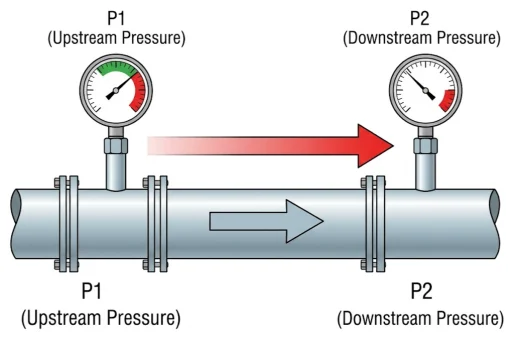
To grasp the essence of pressure drop, one must first view a fluid system through the lens of thermodynamics. Pressure, in this context, is a manifestation of the internal energy of the fluid. As a liquid or gas moves from point A to point B within a conduit, it inevitably encounters resistance. This resistance necessitates the consumption of energy to maintain motion. Consequently, the pressure at the downstream point is invariably lower than at the upstream source.
In a perfectly idealized, frictionless environment—the kind described in basic Newtonian physics—fluid would flow indefinitely without a loss in pressure. However, in the physical world, entropy persists. We define pressure drop as the difference in total pressure between two points of a fluid-carrying network. This loss is essentially the conversion of mechanical energy into thermal energy, which then dissipates into the environment. It is the “tax” that physics levies on every moving substance within an industrial system.
The magnitude of this drop is influenced by a complex interplay of variables: the velocity of the fluid, its physical properties such as viscosity and density, and the geometric configuration of the path it travels. In any industrial application, from high-pressure steam lines to delicate chemical dosing systems, managing this ΔP is the difference between a system that thrives and one that fails prematurely due to energy starvation or mechanical fatigue.
What Causes Pressure Drop? Understanding Major and Minor Losses
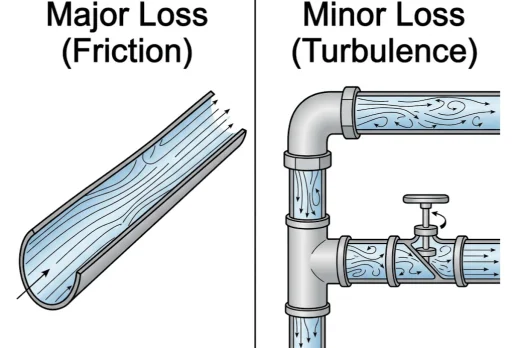
The total pressure drop in a system is rarely the result of a single factor. Engineers categorize these losses into two primary types: major losses and minor losses. While the nomenclature might suggest a hierarchy of importance, in many compact industrial skids, “minor” losses can actually exceed “major” ones.
Pipeline Friction and Roughness (Major Losses)
Major losses refer to the pressure drop occurring along the straight lengths of pipe. This is primarily a function of skin friction between the moving fluid and the internal surface of the pipe. At the microscopic level, no pipe wall is perfectly smooth. Whether it is stainless steel, carbon steel, or high-density polyethylene, the internal surface possesses a degree of “roughness” that disrupts the fluid layers closest to the wall.
In a laminar flow regime, where fluid moves in smooth, parallel layers, the pressure drop is relatively predictable and varies linearly with velocity. However, most industrial applications operate in the turbulent regime. Here, the fluid particles move chaotically, and the interaction with the pipe’s internal roughness becomes more violent. The Darcy-Weisbach equation is the gold standard for calculating these losses:
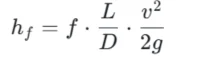
Where:
- f is the friction factor (determined by the Reynolds number and relative roughness).
- L is the length of the pipe.
- D is the inner diameter.
- v is the flow velocity.
As the fluid velocity increases, the pressure drop increases by the square of that velocity. This means that doubling the flow rate through the same pipe doesn’t just double the pressure drop—it quadruples it. Furthermore, as pipes age, corrosion and scale buildup increase the internal roughness, leading to a progressive rise in major losses over the lifecycle of the system.
Internal Components and Directional Changes (Minor Losses)
Minor losses are the pressure drops attributed to specific components within the system, such as valves, bends, tees, expansions, and contractions. These components force the fluid to change direction, change velocity, or navigate through restrictive geometries.
Whenever a fluid encounters a 90-degree elbow or a partially closed valve, the smooth flow pattern is disrupted, creating eddies and vortices. This turbulence consumes a significant amount of kinetic energy. In complex industrial layouts where space is at a premium, the cumulative effect of these fittings often dictates the total system head. For instance, a standard globe valve, due to its tortuous internal path, creates a much higher pressure drop than a full-port ball valve. Engineers often use the “equivalent length” method to simplify these calculations, treating each fitting as if it were a specific length of straight pipe that would produce an identical pressure loss.
Understanding the Effects: How Pressure Drop Impacts Fluid Flow Efficiency and Safety
The implications of an unmanaged pressure drop extend far beyond mere energy loss. It fundamentally alters the behavior of the fluid and the integrity of the hardware.
One of the most immediate effects is the reduction in flow efficiency. If the pressure drop across a system is higher than anticipated during the design phase, the pump or compressor may be unable to deliver the required volume of fluid to the end-use point. This leads to operational bottlenecks. In HVAC systems, this might manifest as insufficient cooling in certain zones; in a chemical plant, it could mean the failure of a reactor to receive the necessary cooling water, leading to a thermal runaway.
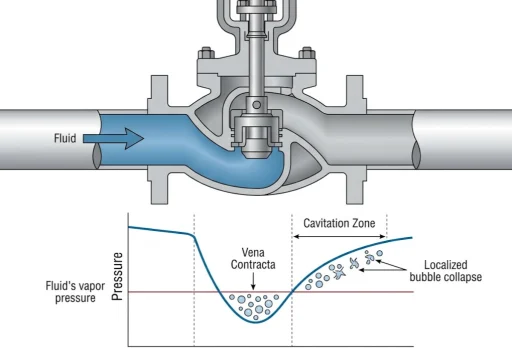
Safety is also a paramount concern. When a liquid experiences a sharp drop in pressure—often as it passes through a restrictive valve trim—the local pressure may fall below the fluid’s vapor pressure. This causes the liquid to boil and form vapor bubbles, a phenomenon known as flashing. If the pressure subsequently recovers downstream, these bubbles collapse with immense force, leading to cavitation. Cavitation produces noise, vibration, and localized “micro-jets” of liquid that can pit and erode even the hardest metal surfaces.
Furthermore, excessive pressure drop correlates directly with high velocity and turbulence, which increases the mechanical vibration within the piping. Over time, this vibration can lead to fatigue failure of welds, supports, and sensitive instrumentation. Therefore, monitoring ΔP is not just about efficiency; it is a vital part of a comprehensive asset integrity program.
The Engineering Math: Calculating Delta P and the Importance of Cv Value
For a manufacturer of actuated valves, the most critical mathematical tool is the Flow Coefficient, or Cv. While the Darcy-Weisbach equation is excellent for pipes, the Cv value is the standard for quantifying the flow capacity of a valve relative to the pressure drop across it.
The Cv value is defined as the volume of water (in US gallons) at 60°F that will flow through a valve per minute with a pressure drop of 1 psi. The basic formula for liquid flow is:
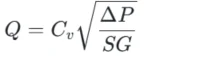
Where:
- Q is the flow rate (gpm).
- ΔP is the pressure drop across the valve (psi).
- SG is the specific gravity of the fluid.
This equation is the bridge between theoretical physics and hardware selection. If an engineer knows the required flow rate (Q) and the maximum allowable pressure drop (ΔP) that the system can tolerate without compromising the pump’s capacity, they can calculate the required Cv and select the appropriate valve size from a manufacturer’s catalog.
In gas service, the calculation becomes significantly more complex due to the compressibility of the fluid. Factors such as absolute inlet pressure, temperature, and whether the flow is “choked” (reaching sonic velocity at the valve throat) must be accounted for. Regardless of the fluid state, the Cv remains the definitive metric of a valve’s “aerodynamic” or “hydrodynamic” efficiency. A higher Cv for a given valve size indicates a more streamlined internal path and a lower inherent pressure drop.
Operational Diagnostics: A Systematic Troubleshooting Matrix for Fluid Systems
In the operational life of a processing plant, pressure drop is rarely a static value; it is a dynamic indicator of system health. When a facility manager observes that “system pressure is insufficient,” they are witnessing a symptom that requires a rigorous diagnostic framework to resolve. Effective troubleshooting is not an exercise in guesswork, but a systematic isolation of variables—balancing the energy provided by the prime mover (the pump or compressor) against the resistance imposed by the network.
To diagnose an underperforming system, one must categorize observations into a logical matrix based on the relationship between flow rate (Q) and differential pressure (ΔP).
Scenario A: Abnormally High ΔP with Reduced Flow
When the pressure drop across a specific segment—such as a valve station or a filter bank—exceeds the design parameters, the system is experiencing excessive resistance. The diagnostic logic points toward three primary culprits:
- Internal Obstruction (The Clogging Phenomenon): In many industrial circuits, the gradual accumulation of debris or scale within a filter or strainer increases the internal “roughness” and reduces the effective flow area. This forces the fluid to accelerate through smaller orifices, leading to a spike in ΔP.
- Valve Misalignment or Incorrect Trim: If an actuated valve is not calibrated to reach its full-open position, or if the internal trim has been replaced with a lower Cv variant, the valve becomes a permanent bottleneck.
- Undersized Piping for System Expansion: Often, plants increase their production capacity by adding new end-use points without upgrading the header piping. This forces a higher velocity through existing conduits, where the ΔP increases by the square of the velocity, as dictated by the Darcy-Weisbach equation.
Scenario B: Low Flow Despite “Normal” or Low ΔP
This is a more subtle failure mode. If the pressure drop across the valves and fittings appears to be within design limits, yet the terminal equipment is not receiving sufficient fluid, the issue is likely energy-source deficiency rather than flow resistance.
- Pump/Compressor Performance Decay: Centrifugal pumps operate on a specific “head-capacity curve.” As internal impellers wear or seals degrade, the pump may no longer be able to provide the required “Total Dynamic Head” (TDH) to overcome even a normal pressure drop.
- System Bypassing: In complex loops, a partially open bypass valve or a leaking internal seal can allow fluid to take the path of least resistance, effectively “stealing” pressure from the main process line.
- Inaccurate Instrumentation: Before initiating mechanical repairs, one must verify the transducers. A drifted pressure sensor can provide a false sense of security, masking a deeper systemic issue.
The Diagnostic Matrix: Symptoms and Causal Links
To simplify the field assessment, Vincer suggests the following diagnostic logic:
Observation | Primary Suspect | Recommended Action |
High ΔP across filter/strainer | Clogging or scaling | Clean or replace internal elements. |
High ΔP across valve (fully open) | Incorrect Cv or mechanical obstruction | Verify valve positioner calibration and trim size. |
Flow is low, but ΔP is also low | Pump/Source failure | Inspect pump impellers and check for motor RPM drops. |
Sudden ΔP spike with noise | Cavitation or “Choked Flow” | Reduce upstream pressure or install a multi-stage trim valve. |
Gradual ΔP increase over months | Pipeline corrosion/fouling | Implement chemical cleaning or pigging of the line. |
By approaching pressure drop as a diagnostic tool rather than a mere loss, engineers can move from reactive maintenance to proactive optimization. At Vincer, we encourage our partners to view the ΔP across our actuated valves as a continuous “health check” for the entire fluid circuit. Solving these technical anomalies is not just an engineering task; it is a financial necessity, as evidenced by the operational realities across various industries.
Industry Realities: Where Pressure Drop Impacts Your Operations
To see the tangible impact of these principles, we must look at specific industrial sectors. The pipe network is the “circulatory system” of the modern factory, and pressure drop is the resistance it must overcome to stay alive.
In HVAC systems, static pressure drop in ductwork is a constant battle. If the air filters are clogged or the dampers are poorly calibrated, the fan must work harder, leading to a spike in energy consumption. In large commercial buildings, even a minor reduction in the design pressure drop can result in thousands of dollars in annual electricity savings.
In compressed air systems, pressure drop is essentially lost money. Generating compressed air is one of the most expensive utility costs in a manufacturing plant. If a system experiences a 10 psi drop due to undersized piping or excessive fittings between the compressor and the tool, the compressor must be set to a higher discharge pressure to compensate. This not only increases the energy bill but also accelerates the wear and tear on the compressor’s internal components.
In industrial process control, such as in oil refineries or water treatment plants, the pressure drop across a control valve is used to modulate flow. However, if the valve is oversized, it must operate near its seat to create the required drop, leading to instability and “hunting.” Conversely, an undersized valve will create a permanent bottleneck, forcing the main feed pumps to consume excessive power to push the fluid through the restriction.
Why Pressure Drop is the Deciding Factor for Actuated Valve Performance
As a manufacturer of actuated valves, Vincer understands that pressure drop is the primary variable determining the mechanical load on the execution hardware. An actuated valve—whether pneumatic or electric—must do more than just sit in the line; it must be able to move against the forces generated by the fluid.
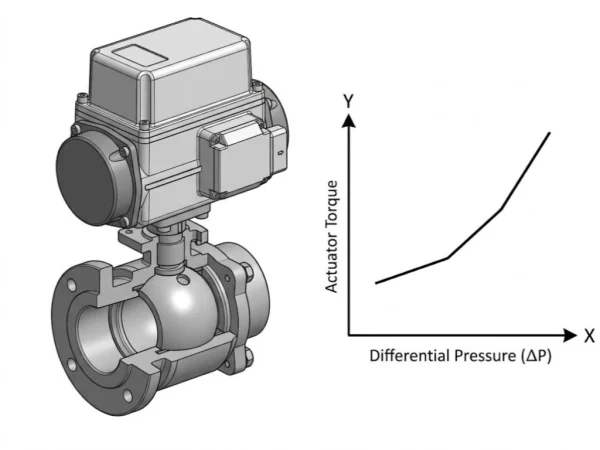
Calculating Actuator Torque Requirements Under High Delta P
The relationship between ΔP and actuator torque is direct and formidable. When a ball valve or butterfly valve is in the closed position, the upstream pressure (P₁) pushes the closure element (the ball or disc) against the downstream seat. The higher the differential pressure (ΔP = P₁ – P₂), the greater the friction between the sealing surfaces.
To open the valve, the actuator must provide enough “breakaway torque” to overcome this static friction. If the pressure drop is higher than the design specification, a standard actuator might stall, or an electric motor might overheat and trip its thermal protection. Furthermore, as the valve begins to open, the fluid velocity increases, creating dynamic forces (hydrodynamic torque) that can either assist or oppose the actuator’s movement. At Vincer, we don’t just look at the valve size; we perform rigorous torque calculations based on the customer’s specific ΔP to ensure the actuator is perfectly matched to the application.
Vincer Solutions: Precision-Engineered Valves for Extreme Environments
Vincer’s engineering philosophy centers on neutralizing the destructive forces of pressure drop while maximizing the longevity of the actuated assembly. As the “gatekeeper” of your process, our valves are engineered for the most demanding sectors, including Water Treatment, Oil & Gas, Desalination, Chemical Processing, and Erneuerbare Energie.
Our solution-driven approach focuses on three core pillars:
- Precision Actuation: VINCER Elektroventile are designed for seamless automation integration, offering low power consumption and optimized flow control. Simultaneously, our pneumatische Aktoren provide rapid-response solutions—achieving speeds of less than one second—to ensure optimal safety and process efficiency.
- Manufacturing Excellence: We manage every stage from raw material selection to final assembly with surgical precision. By utilizing advanced production technology, we maintain a 95%+ qualification rate, ensuring robust, leak-proof performance in even the most corrosive environments.
- Sustainable Reliability: Our valves are built to withstand high shear forces while reducing environmental impact through consistent, low-maintenance operation.
Whether in wastewater treatment or pharmaceutical production, Vincer provides intelligent fluid control solutions that transform high ΔP challenges into stable, energy-efficient operations.
Practical Tips to Minimize Unwanted Pressure Losses in Your System
Reducing unwanted pressure drop is a multifaceted challenge that requires attention at every stage of the system lifecycle:
- Optimize Pipe Sizing: Do not undersize pipes to save on initial material costs. The long-term energy cost of a high-velocity, high-pressure drop system far outweighs the savings on smaller diameter steel.
- Select Full-Port Valves: Where modulation is not required, use full-port ball valves. These offer a “straight-through” flow path that makes them virtually invisible to the fluid, with a Cv nearly equal to a piece of straight pipe.
- Rationalize Fittings: Every elbow and tee is a point of energy loss. Simplify your piping layout to minimize changes in direction. Use long-radius elbows instead of short-radius ones where possible.
- Monitor System Health: Install pressure gauges or transmitters upstream and downstream of critical components like filters and heat exchangers. A rising ΔP across a filter is a clear signal that maintenance is required.
- Use High-Performance Actuated Valves: Ensure your control valves are correctly sized. A valve that is too large or too small for the required pressure drop will lead to poor control and increased system turbulence.
Schlussfolgerung
Pressure drop is an inescapable reality of fluid transport, a fundamental expression of the laws of physics that govern industrial operations. From the microscopic friction at the pipe wall to the massive mechanical loads placed on an actuated ball valve, ΔP dictates the boundaries of what is possible in system design. By understanding its causes—both major and minor—and accurately calculating its effects through metrics like the Cv value, engineers can design systems that are not only functional but exceptionally efficient. At Vincer Valve, we remain dedicated to providing the hardware and the expertise necessary to master these forces, ensuring that your fluid control systems operate with the precision and reliability that modern industry demands.
FAQS
Q: What is valve pressure drop?
Valve pressure drop (ΔP) is the difference between the fluid pressure at the valve’s inlet (P1) and the outlet (P2). It represents the energy lost as fluid overcomes the internal resistance, friction, and turbulence created by the valve’s trim and flow path.
Q: What is the rule of thumb for control valve pressure drop?
For effective control, the standard rule of thumb is that the pressure drop across a control valve should be at least 25% to 33% (one-third) of the total dynamic pressure drop of the system at maximum flow. Alternatively, a minimum drop of 10–15 psi (0.7–1.0 bar) is often cited to ensure the valve maintains authority over the flow.
Q: What does PN-40 mean on a valve?
PN stands for Pression Nominale (Nominal Pressure). The number 40 indicates the pressure rating in bars. Therefore, PN-40 means the valve is designed to operate at a maximum working pressure of 40 bar at a reference temperature (typically 20°C).
Q: What is the critical pressure drop of a valve?
The critical pressure drop is the point at which the flow through the valve becomes “choked.” At this stage, increasing the pressure drop further will not increase the flow rate because the fluid has reached sonic velocity (in gases) or is undergoing significant vaporization/cavitation (in liquids) at the narrowest point (vena contracta).
 English
  French
  Spanish
  Italian
  German
  Dutch
Dutch  Portuguese
  Korean
  Russian
  Chinese
  Finnish