في كل عام، تقوم فرق المشتريات في جميع أنحاء جنوب شرق آسيا والشرق الأوسط وأوروبا بتقييم العشرات من الشركات المصنعة للصمامات الفراشية الهوائية. ويقوم البعض بإرسال طلبات عروض الأسعار إلى 20 مصنعًا ومقارنة جداول أسعار “فوب” (FOB). وينتهي الأمر بمعظمهم في حيرة من أمرهم — لأن السؤال الحقيقي ليس “من الذي يصنع هذا الصمام”، بل «من الذي يصنعه لشخص مثلي».”
يختلف ما يحتاجه مقاول مشروع يقوم بتوريد الصمامات لمحطة تحلية مياه سعودية اختلافًا جوهريًّا عما يحتاجه موزع يحتفظ بمخزون لمقاولي أنظمة التدفئة والتهوية وتكييف الهواء (HVAC) في دبي. ومع ذلك، تعامل معظم أدلة التوريد جميع المشترين على أنهم نفس الشخص. يتبنى هذا المقال نهجًا مختلفًا: سنقوم بتصنيف الشركات المصنعة حسب نوع المشتري، وسنستند في كل توصية إلى بيانات حقيقية عن الشركات، وسنقدم لك إطار عمل قابل للتحقق منه لوضع قائمة مختصرة — سواء كنت مدير مشروع EPC، أو موزع صمامات، أو مشتريًا للمشتريات بالجملة.
لماذا يُعد الجزء “الهوائي” أكثر أهمية مما تتصور
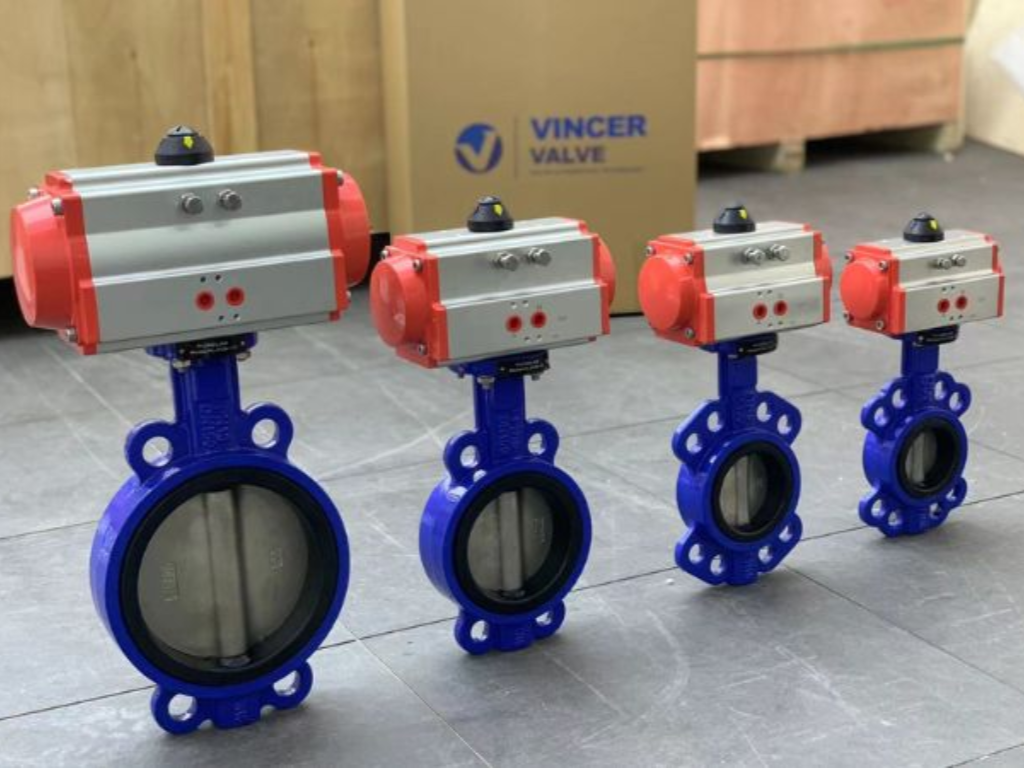
في غرفة التحكم بإحدى محطات تحلية مياه البحر، يضغط أحد المشغلين على زر. وبعد ثانيتين، يكمل صمام فراشة هوائي دورة قدرها 90 درجة، مما يؤدي إلى عزل مجموعة أغشية التناضح العكسي. لماذا هوائي وليس كهربائي؟ لأن الصمام يقع في بيئة رطبة قد تكون مسببة للتآكل، حيث ستحتاج المشغلات الكهربائية إلى أغلفة باهظة الثمن مقاومة للانفجار أو مقاومة للماء — ولأن المشغل الهوائي ذي العودة الزنبركية سيغلق الصمام تلقائيًا في حالة انقطاع إمداد الهواء، مما يحمي أصول الأغشية التي تبلغ قيمتها ملايين الدولارات.
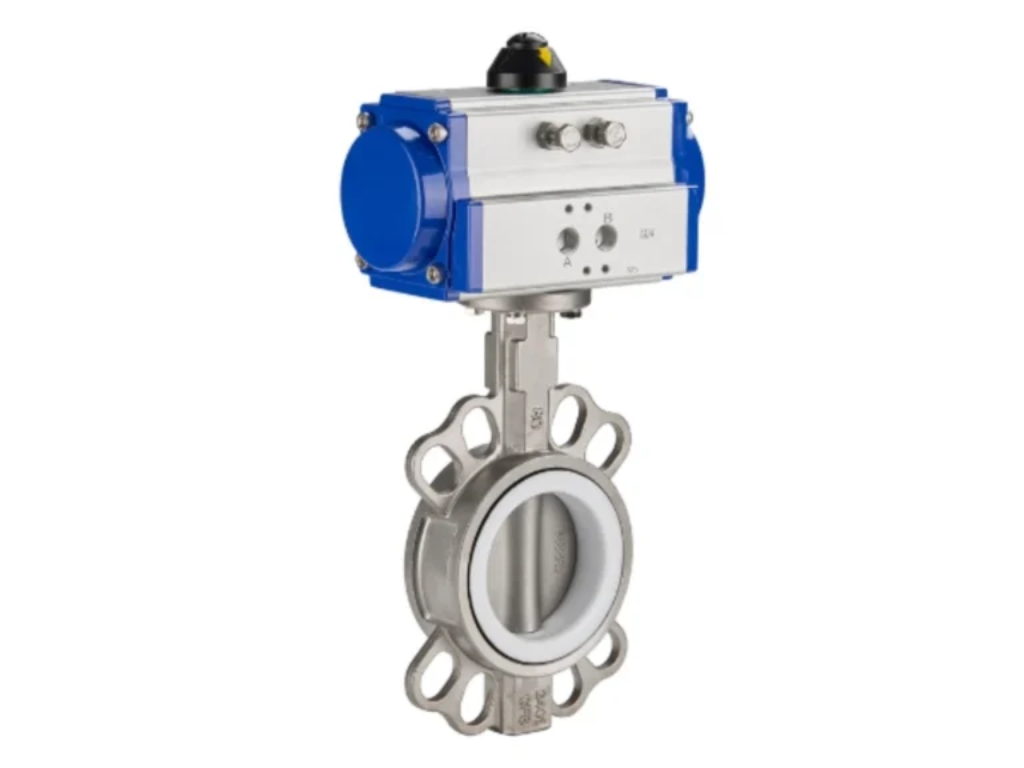
هذه هي الحقيقة الأساسية بشأن الصمامات الفراشية الهوائية: فهي ليست سلعة عادية. يجب أن يتوافق المشغل وجسم الصمام معًا كنظام واحد. وهناك ثلاثة قرارات تحدد ملامح هذا النظام:
- نوع المشغل: نظام مزدوج المفعول (هواء-هواء، يبقى في موضعه عند انقطاع الهواء) مقابل نظام العودة الزنبركية (آمن في حالة الفشل، يعود إلى الوضع المفتوح أو المغلق عند انقطاع الهواء). يعتمد الاختيار على ما إذا كانت العملية الخاصة بك يمكنها تحمل بقاء الصمام في آخر وضع له أثناء توقف المصنع عن العمل.
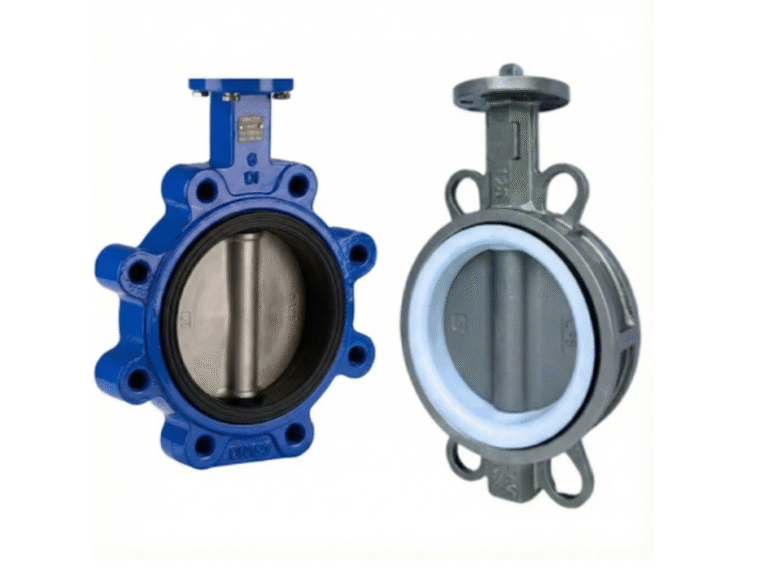
- وصلة الصمام: نوع «الرقاقة» (محصور بين حافتين، وأقل تكلفة)، أو نوع «العروة» (إدخالات ملولبة للاستخدام في الأطراف المسدودة)، أو نوع «الحافة» (حافة كاملة، وأعلى مستوى من السلامة الهيكلية). يعتمد الاختيار على ما إذا كنت بحاجة إلى فصل أحد جانبي خط الأنابيب بينما يظل الجانب الآخر تحت الضغط.
- مادة المقعد: EPDM (من −20 درجة مئوية إلى 120 درجة مئوية، للاستخدام العام مع المياه)، أو PTFE (حتى 180 درجة مئوية، مقاوم للمواد الكيميائية)، أو Viton (حتى 200 درجة مئوية، للاستخدام مع الهيدروكربونات). إن الخطأ في اختيار المادة المناسبة يعني أن الصمام سيتسرب في غضون أشهر — وليس سنوات.
يجب تركيب جميع المشغلات الهوائية عن طريق ISO 5211 فلنجات قياسية، مما يضمن إمكانية التبادل بين مختلف ماركات المشغلات. ويجب أن يستوفي مصدر الهواء المضغوط ISO 8573-1 الفئة 5.4.3 على الأقل — يمكن أن يتسبب هواء المحطة غير المُصفى في تآكل الأجزاء الداخلية للمشغل (ISO 8573-1, 2010).
إن فهم هذه الأساسيات يضعك على خط البداية. أما التحدي الحقيقي فيبدأ الآن: وهو العثور على شركة مصنعة يتوافق نموذج أعمالها مع نموذج أعمالك.
اختيار الشركة المصنعة المناسبة لنموذج عملك
إليكم حقيقة يغفلها معظم أدلة التوريد: ينقسم مصنعو الصمامات الفراشية الهوائية على مستوى العالم إلى فئتين — الموردون من الفئة الهندسية الذين يخدمون مقاولي المشاريع، والموردون من الفئة التجارية الذين يخدمون الموزعين وتجار الجملة. واختيار الفئة الخاطئة يكلف أكثر من اختيار العلامة التجارية الخاطئة ضمن الفئة الصحيحة.
قبل أن نتطرق إلى شركات تصنيع محددة، إليكم مصفوفة اتخاذ القرار حسب نوع المشتري التي تشكل الأساس لكل ما سيأتي بعد ذلك:
| البعد القراري | منظور المقاول المسؤول عن المشروع | منظور الموزع/تاجر الجملة |
|---|---|---|
| أعلى القيم | اكتمال الشهادات، الدعم الهندسي، سجل الإنجازات في المشاريع السابقة | استقرار فترة التسليم، هيكل الهامش، قابلية نقل العلامة التجارية |
| حساسية السعر | متوسط (تتراوح النسبة بين 3 و51 TP3T من ميزانية المشروع) | مرتفع (هامش الربح الإجمالي هو مؤشر الأداء الرئيسي) |
| الحاجة إلى الدعم الفني | التصميم التفصيلي (تصميم المقترح، الرسومات ثنائية الأبعاد وثلاثية الأبعاد، التشغيل التجريبي للموقع) | متوسط (وثائق المنتج، قطع الغيار، الضمان) |
| نمط الطلب النموذجي | على أساس المشروع (50–500 وحدة، لمرة واحدة) | متكررة (عمليات إعادة الطلب الشهرية/الربع سنوية) |
| تفاوت مهلة التسليم | فترة تتراوح بين 8 و16 أسبوعًا مقبولة | من المتوقع أن يستغرق الأمر من 2 إلى 6 أسابيع |
| متطلبات العلامة التجارية | تم تحديده من قبل المستشار الهندسي | قابلة للتسويق، أو معروفة، أو قابلة للتسويق تحت علامة تجارية بيضاء |
- مجموعة شهادات متعمقة (API، ATEX، SIL)
- دعم هندسي كامل (رسومات ثنائية الأبعاد وثلاثية الأبعاد، والتشغيل)
- مدة التنفيذ من 8 إلى 16 أسبوعًا، والتسعير يعتمد على كل مشروع على حدة
- مواعيد تسليم سريعة (2–6 أسابيع)، إمدادات يمكن التنبؤ بها
- هوامش ربح تنافسية (25–40% بعد احتساب تكاليف الشحن)
- قابلية نقل العلامة التجارية أو إمكانية استخدام العلامة البيضاء
بالنسبة لمقاولي المشاريع — مستوى الشهادات، والدعم الهندسي، والمكان الفعلي للتصنيع
يعيش مقاولو المشاريع في عالم يمكن أن يؤدي فيه خطأ واحد في مواصفات الصمام إلى سلسلة من المسؤوليات — بدءًا من الاستشاري الهندسي الذي كتب المواصفات، مرورًا بشركة الهندسة والمشتريات والبناء (EPC) التي قامت بشراء الصمام، وصولاً إلى مالك المحطة الذي يقوم بتشغيله. والخيار الأكثر أمانًا هو ذلك الذي لن يُلام أحد عليه.
إذا كان مشروعك في مجال النفط أو الغاز أو البتروكيماويات, ، وعلامتا «فيشر» و«كيستون» التابعتان لشركة «إيمرسون» (إيمرسون) هي الإعدادات الافتراضية. إن API 6D, ATEX, ، و SIL 3 تعد تغطية الشهادات هي الأوسع نطاقًا في هذا القطاع، كما أن شبكة خدماتها العالمية تضمن وصول مشغل بديل إلى محطة غاز في نيجيريا أو منصة في بحر الشمال في غضون أيام. لكن المقابل هو السعر: DN100 PN16 صمام فراشة هوائي من الفولاذ المقاوم للصدأ من شركة إيمرسون، طراز $200–500 FOB, ، وتعتبر فترات التسليم التي تتراوح بين 12 و16 أسبوعًا هي المعيار السائد (إيمرسون — مجموعة منتجات الصمامات الفراشية الهوائية ونطاق الشهادات، تقرير QY Research العالمي عن سوق الصمامات الفراشية الآلية، 2025).
إذا كان مشروعك في مجال معالجة المياه أو البنية التحتية البلدية, ، أما الخيارات الأكثر دقة فهي KSB وBray International. سلسلة BOAX-B من KSB (KSB) يتناسب مع DN 1000 ويحمل DVGW, ACS, ، و WRAS تصاريح مياه الشرب — وهي شهادات لا توليها شركة إيمرسون أولوية لأن قطاع المياه لا يمثل سوقها الأساسي. شركة براي إنترناشونال (براي)، التي يقع مقرها الرئيسي في هيوستن، هي واحدة من أكبر الشركات المصنعة للصمامات الدوارة في العالم من حيث الحجم، حيث تنتشر صمامات الفراشة ذات المقاعد المرنة التي تنتجها في آلاف محطات معالجة المياه على مستوى العالم. وتكمن ميزة شركة «براي» في فعالية التكلفة على المستوى الهندسي — حيث تكون أسعارها عادةً أقل بنسبة 30–40% من أسعار شركة «إيمرسون» بالنسبة للمواصفات المخصصة لمياه الشرب (براي إنترناشونال — الملف التعريفي للشركة ومجموعة المنتجات، Crunchbase، 2025).
إذا كان مشروعك يقع في منطقة آسيا والمحيط الهادئ ويتطلب الامتثال لمعايير JIS, ، شركة كيتز (كيتز) هي الخيار الأمثل. تتميز صمامات الفراشة من «كيتز» بقدرة تخفيض التدفق بنسبة 250:1، كما أنها حاصلة على شهادة JIS الكاملة — وهو أمر مهم لمشاريع البنية التحتية الممولة من اليابان في جميع أنحاء جنوب شرق آسيا، حيث يُشترط الامتثال لمعايير JIS في اتفاقية القرض (شركة «كيتز» — ملف العلامة التجارية والشهادات، الموقع الإلكتروني العالمي لشركة «كيتز»، 2025).
FOBFOBFOBتشترك جميع الشركات المصنعة للمنتجات الهندسية في سمة واحدة: فترات تسليم تتراوح بين 8 و16 أسبوعًا، وشروط الدفع مقدمًا، وكميات طلب أدنى تجعل الطلب التجريبي المكون من 10 وحدات غير مجدٍ اقتصاديًّا. هذه ليست نقاط ضعف. إنها خصائص سلسلة توريد مصممة لمشاريع تكون فيها حزمة الصمامات $500,000 بندًا واحدًا ضمن ميزانية نفقات رأسمالية تبلغ $500 مليون.
بالنسبة للمقاولين الذين لا تتطلب مشاريعهمAPI 6Dأو الحصول على شهادة الملاءمة للاستخدامات النووية، فإن الفجوة بين الشركات المصنعة على المستوى الهندسي وتلك العاملة على المستوى التجاري هي المجال الذي تعمل فيه شركات مثل «فينسر» (دونغقوان، تأسست عام 2010). تقدم Vincer منهجية اختيار على المستوى الهندسي — وهي تحليل ذو 8 أبعاد يشمل الوسائط، ودرجة الحرارة، والضغط، ومعايير التوصيل، ووضع التحكم، ومتطلبات المواد، وخصائص الصناعة، والمعايير المعمول بها — ولكنها توفر منتجاتها في غضون فترات تسليم على المستوى التجاري (7–10 أيام للمنتجات القياسية، و30 يومًا للطلبات المخصصة) دون حد أدنى لكمية الطلب. المقايضة الصادقة: تمتلك VincerISO 9001,CE,RoHS,SIL, ، وFDAالشهادات (معATEX(في خارطة الطريق)، لكنه يفتقر إلىAPI 6Dومؤهلات في المجال النووي. بالنسبة لمشروع معالجة المياه أو مشروع صناعي عام تتطلب فيه ورقة المواصفاتCE+ISO 9001+FDA, ، هذه المجموعة كافية. أما بالنسبة لمنصة بحرية، فهي غير كافية.
للموزعين وتجار الجملة — موثوقية التوريد، وهيكل الهامش، وقابلية نقل العلامة التجارية
يعمل الموزعون وتجار الجملة وفقًا لمعايير مختلفة. أداء الصمامات مهم — فالصمام المتسرب يؤدي إلى طلب إرجاع المنتج ويقوض ثقة العميل النهائي. لكن هناك عوامل أخرى لا تقل أهمية، مثل القدرة على التنبؤ بمدة التسليم (لن ينتظر عميلك 12 أسبوعًا)، وهيكل هامش الربح الإجمالي (يجب أن تحقق ربحًا يتراوح بين 25 و40% بعد خصم تكاليف الشحن والرسوم الجمركية)، واستعداد الشركة المصنعة لدعم أعمالك من خلال توفير الوثائق والعينات والدعم الفني.
إذا كنت تقوم بالتوزيع في أمريكا الشمالية أو أوروبا, Valworx (Valworx) and Tomoe Valve (Tomoe) represent two distinct strategies. Valworx (Cornelius, NC, ISO 9001) specializes in automation-ready valves — pneumatic butterfly valves in double-acting and spring-return configurations, built, tested, and shipped the same day if ordered before 3 PM Eastern. Their 1-year warranty and 60-day return policy make them a low-risk entry point for distributors adding pneumatic automation to a manual-valve catalog (Valworx — company profile, CBInsights, 2025). Tomoe, with its Japanese engineering heritage and UK-based European distribution, is a butterfly valve specialist with 57-country export reach — a strong choice for distributors who want a recognized butterfly-valve brand name rather than a generalist valve supplier (Tomoe Valve — export success story, Business Wales, 2025).
If you're wholesaling to price-sensitive markets in the Middle East, Africa, or South Asia, the cost equation shifts. UFLOW Automation (UFLOW) out of Rajkot, India, holds ISO 9001:2008 certification from TÜV SÜD and manufactures pneumatic butterfly valves from DN 40 to DN 250 مع API 609 و ASME B16.5 150# compliance. Unox Vana out of Turkey uses the Turkey-EU Customs Union for zero-tariff access to European markets and shorter shipping routes to the Middle East. Both operate at FOB price points 40–60% below engineering-tier manufacturers, but both require the buyer to verify Mill Test Reports (MTRs) per EN 10204 3.1 for every batch — this is non-negotiable for any wholesale buyer who doesn't want to discover that batch #3 arrived in SS201 instead of SS304 (UFLOW Automation — manufacturing profile, IndiaMART, 2025).
1-year warranty, 60-day returns
Japanese engineering heritage
API 609, ISO 9001:2008
40–60% below engineering tier
The critical rule for trade-grade buyers: Never place a 500-unit order as a first transaction. Start with a 10–20 unit trial order, request batch-specific MTRs and hydrostatic test videos (per API 598: 士体试验 = 1.5 × rated pressure, 密封试验 = 1.1 × rated pressure), and verify material composition with a handheld PMI analyzer if possible. A manufacturer who can't or won't provide these for a trial order won't provide them for a container load either.
- Start with 10–20 units — never place a 500-unit order as a first transaction
- Demand batch-specific
MTRs perEN 10204 3.1and hydrostatic test videos perAPI 598 - Verify material composition with a handheld
PMIanalyzer when possible
For distributors and wholesalers serving water treatment, food processing, or general industrial markets, a Chinese manufacturer that consolidates 12 product categories — pneumatic butterfly valves plus electric valves, control valves, manual valves, and accessories — under a single supplier relationship reduces procurement overhead compared to managing three separate single-category vendors. Vincer's 24-hour quotation turnaround for standard inquiries (48 hours for multi-product project packages) andMTRdocumentation for all wetted parts are baseline expectations in this segment. The 8-dimension selection methodology — which is Vincer's standard pre-sales process — also functions as an informal technical training layer for non-engineering wholesale teams: when your salesperson can present a selection rationale to their customer, they're selling value instead of just price. The honest limitation: Chinese brands face a recognition gap in North American and European distribution channels compared to Valworx or Tomoe. They are most competitive in markets (Southeast Asia, Middle East, Africa, Australia) whereCE+ISO 9001+ competitive pricing + fast logistics outweigh brand origin as a decision factor.
The Certifications That Actually Matter (and Which Ones You Can Skip)
A manufacturer's website displaying 15 certification badges looks impressive. It also tells you nothing — unless you know which certifications are issued by accredited bodies with publicly verifiable databases, and which are self-declared marketing graphics.
The table below maps certifications to the industries where they are a genuine requirement versus where they are optional:
| Certification | What It Actually Means | Required For | Optional For |
|---|---|---|---|
| ISO 9001 | Quality management system | All industries (minimum baseline) | — |
| CE Marking | EU market access (self-declared or Notified Body verified) | Export to EU | Purely Asia/Middle East/Africa projects |
| API 609 | Butterfly valve design standard | Oil and gas, petrochemical | Water treatment, food processing, general industry |
| ATEX/IECEx | Explosion-proof certification | Chemical plants, oil refineries, mining, gas processing | Water treatment, HVAC, food and beverage |
| SIL (مستوى سلامة التكامل) | Safety loop reliability — applies to the entire final element assembly | Petrochemical/nuclear Emergency Shutdown systems | Standard on/off valve applications |
| FDA | Food-contact material compliance | Food, beverage, pharmaceutical, cosmetics | Industrial media (water, chemicals, steam) |
| WRAS/ACS/DVGW | Drinking water safety (UK/France/Germany) | Municipal water supply in respective countries | Non-potable water or non-EU projects |
ISO 9001 with product-level API 609 compliance — a manufacturer may hold one without the other.The most common certification mistake in valve sourcing is confusing scope. A manufacturer may hold ISO 9001 at the company level, but that doesn't mean their butterfly valve product line is API 609 compliant. A CE marking may be a self-declared Declaration of Conformity (DoC) — legally valid but not independently verified — rather than a Notified Body (NB) audited certificate. For high-liability applications, ask for the NB number and verify it against the European Commission's NANDO database.
Similarly, a SIL rating on a valve body alone is meaningless. SIL certification applies to the complete final element assembly: valve + actuator + positioner + solenoid valve as an integrated unit. If a manufacturer claims SIL 3 but can't provide the FMEDA (Failure Modes, Effects, and Diagnostic Analysis) report for the full assembly, the claim is marketing — not engineering (API 609 Standard, American Petroleum Institute, 2024).
FMEDA report if SIL is claimed — no report means no certification
Here's what matters: before you shortlist any manufacturer, write down the 3–4 certifications your specific project or market actually requires. A Saudi desalination plant needs CE + drinking water approvals. A Nigerian gas processing facility needs API 609 + ATEX Zone 1. Same valve type. Completely different certification floor.
How to Verify a Manufacturer Without Flying to Their Factory
Factory audits are the gold standard for supplier verification. But the reality of B2B valve sourcing is that most first-time buyers never visit a factory before placing an initial order. The good news: a structured remote verification process — combining digital signal analysis with targeted technical questioning — can get you about 70% of the confidence level of an on-site audit.
Digital Audit Signals — What a Manufacturer's Online Presence Reveals
Five digital signals separate credible manufacturers from trading companies with a website:
Signal 1 — Google Maps Satellite View. Search the factory address from the Contact page. A 7,200 m² facility with visible truck-loading bays, raw material storage yards, and a distinct factory roofline is a manufacturer. A residential building or a shared office complex is a trading company. The satellite image doesn't lie.
Signal 2 — Certificate Presentation. A credible manufacturer shows scanned certificate documents with issuing body name, certificate number, scope description, and expiration date. A trading company displays “ISO 9001 Certified” as plain text with a generic badge icon. Ask for the certificate number and verify it on the issuing body's public database. If the number doesn't resolve, move on.
Signal 3 — Technical Depth on Product Pages. A manufacturer's butterfly valve product page includes a pressure-temperature rating table, actuator brand and model compatibility list, body/seat material options with ASTM/EN standard references, and torque requirement charts across the DN range. A trading company's product page says “High Quality, Best Price, Fast Delivery” and shows three stock photos. The difference is visible in 30 seconds.
Signal 4 — Video Evidence. Genuine manufacturers provide pre-shipment videos showing the valve driven by its actuator through a full open-close cycle, with the hydrostatic test pressure gauge readable on screen. The gauge should show 1.5× rated pressure for the shell test and 1.1× for the seat test, per API 598 (API 598 Valve Inspection and Testing, American Petroleum Institute, 2024). If the video only shows a valve sitting on a table with a voiceover, you're watching a marketing asset — not a quality record.
Signal 5 — LinkedIn Activity Quality. A manufacturer's LinkedIn company page that shares technical case studies, project completion photos, and employee posts with engineering content is evidence of an active technical organization. A page that only reposts product catalog links is evidence of a sales-only operation. Neither is disqualifying, but the pattern tells you what kind of company you're dealing with before you send the first email.
The Questions That Reveal Real Manufacturing Capability
Once the digital signals pass, send these questions by email. A real manufacturer answers 8 or more with specific numbers, names, and standards. A trading company answers with assurances.
Basic Verification (3 questions):
1. “How many CNC machining centers do you operate, and what brands/models?” Expected: ≥ 3 units, named brands (Haas, DMG Mori, Mazak, or local equivalent with model numbers). Red flag: “We have enough equipment to meet your needs.”
2. “What is your hydrostatic test pressure for a DN100 PN16 butterfly valve, and which standard do you follow?” Expected: “Shell test at 24 bar (1.5 × PN16), seat test at 17.6 bar (1.1 × PN16), per API 598.” Red flag: “We test 100% of our valves” — without stating the pressure.
3. “Can you provide Mill Test Reports with heat numbers and lot traceability for the valve body and disc?” Expected: “Yes, per EN 10204 3.1, including chemical composition and mechanical properties for each heat.” Red flag: “What is an MTR?”
Production Depth (4 questions):
4. Who supplies your valve body castings, and what casting process do they use? (Sand casting vs. investment casting — surface finish and dimensional accuracy differ significantly.)
5. What O-ring and seal brands do you use as standard, and what brands are available as upgrades? (Parker, Freudenberg, NOK vs. unbranded — leakage rate and service life differ by a factor of 3–5×.)
6. What is your in-house NDT capability? (Magnetic particle, ultrasonic, dye penetrant, or none? If “none,” all quality control happens at final pressure testing — which finds leaks but not casting defects.)
7. Can you produce a 2D general arrangement drawing and a 3D model of the valve with actuator mounted, showing overall dimensions, within 48 hours of request?
After-Sales Commitment (3 questions):
8. What is your standard warranty period, and what exactly does it cover?
9. If a valve leaks within the warranty period, what is your process — and how long from claim to resolution?
10. Do you stock spare parts (seats, seals, O-rings) for valves shipped in the last 5 years, and can you ship a replacement seal kit within 72 hours?
CNC count = trading company, not manufacturerQCMTR?”A manufacturer who answers 8+ of these with concrete detail is worth a trial order. A manufacturer who answers fewer than 5 with specific information is a risk you take with your customer relationship — not just your purchase order.
What You Actually Pay For — Price Tiers Across Manufacturing Regions
الـ FOB price of a DN100 PN16 stainless steel pneumatic butterfly valve varies by a factor of 5–6× across manufacturing regions. The table below positions representative manufacturers on this spectrum:
| منطقة التصنيع | شركات تصنيع ممثلة | FOB النطاق السعري (بالدولار الأمريكي) |
المهلة الزمنية المعتادة | Quality Signal Summary |
|---|---|---|---|---|
| USA/Western Europe | Emerson, KSB | $200–500+ | 8–16 أسبوعًا | Full واجهة برمجة التطبيقات (API)/ATEX/SIL certification stack, global service network, consultant-specified brands |
| Japan | Kitz, Tomoe | $150–350 | 6–12 أسبوعًا | JIS/ASME dual-standard, high machining precision (CNC tolerance ±0.01mm), strong petrochemical pedigree |
| India/Turkey | UFLOW (India), Unox (Turkey) | $60–120 | 4–8 weeks | ISO 9001 baseline, TÜV SÜD or CE certification, growing export volumes |
| China (Quality-Tier) | فينسر | $80–150 | 1–4 weeks | ISO 9001 + CE + RoHS + SIL + FDA, MTR documentation, 8-dimension engineering, 12 product lines |
| China (Price-Tier) | Various B2B platform vendors | $40–80 | 2–6 weeks | Website claims only, certificates not independently verifiable, minimal technical documentation |
The “China (Price-Tier)” category is where the horror stories come from: SS201 sold as SS304, Viton seat specified but EPDM delivered, CE marks that don't resolve on any database. The valve will probably function. For a few months. In a non-critical application where a leak means a puddle on the floor and not a plant shutdown, the $40 valve might even be the rational choice. For anything else, the “choose the second-cheapest option” heuristic holds: the gap between the cheapest offering and the one that won't cause a problem is almost always smaller than the cost of fixing one problem.
The Hidden Costs That Make a “Cheap” Valve Expensive
The Total Cost of Ownership (TCO) for a pneumatic butterfly valve extends far beyond the FOB invoice. Five hidden costs consistently blindside first-time buyers:
1. Material Fraud. You ordered SS304 (8–10.5% nickel content). The valves arrive with a beautiful mirror polish. Six months later, pitting corrosion appears on every valve body. A handheld XRF analysis reveals nickel content at 1.2% — it's SS201, which has roughly 5–10× lower corrosion resistance in chloride environments. Cost of replacement: 2–3× the original purchase price, plus labor to remove and reinstall.
2. Certification Gaps at Customs. Your shipment arrives at Hamburg port. German customs asks for the CE Declaration of Conformity. The supplier sends a one-page PDF with their company logo, a CE symbol, and the text “This product complies with EU standards.” Customs rejects it — a valid DoC must include the manufacturer's legal name and address, product description, list of applicable directives and harmonized standards, and signatory information. The container sits in port for three weeks at €50/day storage fees while you chase documentation that should have accompanied the commercial invoice.
3. Lead Time Overruns. A project contract carries a delay penalty of 0.1–0.5% of contract value per day. On a $5 million project, a 14-day valve delivery delay costs $35,000 in penalties. The $3,000 you saved by choosing the supplier with the faster promised delivery evaporates, with a $32,000 net loss.
4. After-Sales Vacuum. Six months after installation, three out of 50 pneumatic actuators develop internal corrosion from unfiltered plant air. You email the supplier. Their response: “Please send the actuators back to our factory for inspection.” International return shipping plus three weeks of downtime costs more than buying three replacement actuators locally — and you still don't have a root cause fix that prevents the remaining 47 from failing the same way.
5. Documentation Failure at Handover. The project is complete. The plant owner's commissioning team requests complete MTRs and pressure test reports for every valve as part of the handover documentation package. The supplier sends a one-page Word document listing “Material: Stainless Steel, Test: Passed.” The commissioning team rejects it. Final payment is held for two months while you negotiate replacement documentation that the supplier cannot produce because they never did the testing.
TCO = FOB + Freight + Duties + (Defect Rate × Replacement) + (Delay × Penalty)FOB isn't the lowest TCO, trust your math.The rule of thumb: for any valve order above $5,000, calculate TCO = FOB Price + Freight + Duties + (Expected Defect Rate × Replacement Cost) + (Delay Probability × Daily Penalty). If the cheapest supplier's TCO isn't the lowest, your intuition is right — the price difference is buying you risk reduction, not just a brand name.
Your 5-Step Manufacturer Shortlist Framework
Everything in this article converges on a single goal: helping you build a shortlist of 3–5 manufacturers worth sending an RFQ to. Here is the framework, designed to be completed in under 60 minutes:
Step 1 — Define Your Buyer Profile (2 minutes). Are you a project contractor (certifications and engineering support are your top priority), a distributor (brand portability, margin, and documentation), or a wholesaler (price, batch consistency, logistics)? Go back to the buyer-type matrix in H2#2 and write down your priority ranking. If you're a contractor who also does some distribution, rank the contractor criteria first — your reputation rides on installed performance, not on resale margin.
Step 2 — Set Your Certification Floor (3 minutes). Based on your target market and industry, write down the 3–4 certifications that are non-negotiable. Use the certification-industry mapping table in H2#3. A European water treatment project: CE + WRAS/ACS/DVGW. A Middle Eastern oil and gas project: API 609 + ATEX + ISO 9001. Eliminate any manufacturer who can't provide verifiable evidence for every certification on your floor list.
Step 3 — Scan Digital Signals (15 minutes). For each manufacturer still in consideration, run the five digital signals from H2#4: Google Maps satellite view, certificate presentation format, product page technical depth, video evidence quality, and LinkedIn activity pattern. A manufacturer who fails two or more signals is not necessarily fraudulent, but the probability that they are a trading company rather than a manufacturer rises sharply with each fail.
Step 4 — Send the Questions (20 minutes). Email the 10 questions from H2#4 to every manufacturer who passed Step 3. The response quality — not just the answers — is the test. A manufacturer who answers within 24 hours with specific numbers, standard references, and named brands has demonstrated the communication standard you'll receive throughout the relationship. A manufacturer who takes three days to reply with “don't worry, our quality is very good” has demonstrated that standard too.
Step 5 — Calculate TCO, Not FOB (10 minutes). For each shortlisted manufacturer, run the TCO formula from H2#5: FOB + Freight + Duties + (Expected Defect Rate × Replacement Cost) + (Delay Probability × Daily Penalty). Use conservative estimates for defect rate (based on whether you verified MTRs and test videos in Step 3) and delay probability (based on the clarity of their lead time answer in Step 4). The lowest FOB is rarely the lowest TCO.
The final shortlist should contain 3–5 manufacturers across at least two price tiers — never put all your volume with the cheapest supplier, and never assume the most expensive is the most reliable. A balanced shortlist includes one premium benchmark, two mid-tier candidates that match your buyer profile, and one budget option whose risks you've quantified and accepted.
If your shortlist criteria point toward a mid-tier manufacturer combining project-grade technical assessment with China-level cost efficiency and lead time, Vincer (Dongguan, est. 2010) provides pneumatic butterfly valves withISO 9001,CE,RoHS,SIL, ، وFDAcertifications, backed by an 8-dimension application analysis methodology and completeMTRdocumentation. Their documented project track record includes deployments for Festo, Tameson, and Veolia across seven export markets. Send your specifications — media type, operating temperature, working pressure, connection standard, control mode, material preference, industry, and applicable standards — to sales@vincervalve.com. Even if Vincer doesn't make your final shortlist, a detailed quotation returned within 24 hours gives you a concrete reference point for benchmarking every other candidate in your comparison matrix. The goal isn't to buy from any specific manufacturer. It's to buy with enough information that you never regret the decision.
المراجع
- ISO. “ISO 8573-1:2010 Compressed Air — Part 1: Contaminants and Purity Classes.” 2010. https://www.iso.org/standard/46460.html
- American Petroleum Institute. “API 609 — Butterfly Valves: Double-flanged, Lug- and Wafer-type.” 2024. https://www.api.org/products-and-services/standards
- American Petroleum Institute. “API 598 — Valve Inspection and Testing.” 2024. https://www.api.org/products-and-services/standards
- European Commission. “NANDO — New Approach Notified and Designated Organisations.” https://ec.europa.eu/growth/tools-databases/nando/
- QY Research. “Global Automated Butterfly Valves Market Research Report 2025.” 2025. https://www.qyresearch.com/reports/4690214/automated-butterfly-valves
- EN 10204:2004. “Metallic Products — Types of Inspection Documents.” European Committee for Standardization.