
Introducción
The butterfly valve is a masterpiece of the beautiful compromise between fluid flow mechanics and mechanical simplicity in the strict environment of industrial process control. But simplicity in design is often a disguise of great depth for various applications. The most common question that field engineers and procurement specialists are asked is the apparently simple issue of flow direction. Is a butterfly valve directional or is it a symmetrical element that can disregard the direction of the medium it controls?
This guide aims to break the confusion of butterfly valve orientation and offer an analytical framework that fills the gap between the theoretical fluid mechanics and the practical needs of the piping system today. Knowing the physics behind sealing and the structural subtleties of various valve designs, we can guarantee system integrity, reduce energy consumption, and reduce the risks of catastrophic failure.
What is Butterfly Valve Flow Direction and its Importance
To speak of flow direction is to speak of the kinetic energy vector of a closed system. Flow direction, particularly regarding installation direction, in the context of a butterfly valve, is the given direction the medium (liquid, gas, or slurry) follows as it flows through the valve body, in contact with the disc and the sealing seat. Although there are agnostic designs of valves, most high-performance designs are designed with a preferred or mandatory orientation.
The necessity to follow the correct flow direction cannot be overestimated. Mechanically, the seal is dependent on the interaction of the pressure of the medium and the internal components of the valve to define its efficacy. When a valve is fitted in its desirable position, the pressure in the line usually helps to squeeze the disc against the seat, and thus a tighter shut-off is obtained. On the other hand, poor orientation may cause premature wear of the seat, high operating torque, and internal leakage.
There is more than just the immediate mechanical issue; there is the larger economic factor of operational uptime and operational efficiency. A valve that is put in place against its design specifications is a liability- a weak point in the infrastructure that is prone to unplanned repairs. The direction of flow is a major safety consideration in high-pressure or high-temperature conditions, so that the valve fails in a predictable way or that the valve seal remains intact in extreme conditions.

Do All Butterfly Valves Have a Flow Direction
This question is not a yes or no question; it all depends on the internal geometry and the sealing mechanism of the type of valve in question. To see this, we need to divide butterfly valves into two different families: symmetric sealing and asymmetric, eccentric designs.
Concentric (Resilient Seated) Valves: The Bi-directional Flexibility
The most widespread type is the concentric butterfly valve used in low-pressure, general-purpose applications. In this design, the stem goes through the centerline of the disc and the centerline of the valve body. Since the disc is perfectly centered, the sealing contact between the disc edge and the resilient (typically rubber or EPDM) seat is the same, irrespective of the side on which the pressure is exerted.
These types of valves are essentially bi-directional. Proper installation in this case is similar to the structural integrity of a contract; the orientation is flexible, provided that the basic parameters are satisfied. The concentric valve has the benefit of being easy to install in water treatment, HVAC systems, and low-pressure chemical lines. The technicians do not have to be concerned with upstream or downstream orientation because the performance of the valve is the same in both directions. Nevertheless, in bi-directional designs, the pressure difference should be taken into account; although the valve can close in both directions, it may have a side that it prefers to keep its maximum pressure rating longer.
High-Performance (Double/Triple Offset): The Necessity of Preferred Flow
With the entry into the world of high-performance valves, i.e., double and triple offset models, the bi-directional luxury is lost. These valves are designed to be used in high-pressure, high-temperature, and critical-service applications where a robust seat would not work.
The double offset valve has a stem that is not aligned with the centerline of the disc and the centerline of the body. This produces a cam-like movement which minimizes friction on the seat. The triple offset valve introduces a third offset: the conical shape of the sealing surfaces. These counterbalances lead to a design that is essentially asymmetric.
In such arrangements, there is an apparent direction of preferred flow. This is normally where medium pressure forces the disc into the seat, which strengthens the seal. When fitted in the reverse direction, the medium pressure is in fact acting against the sealing mechanism, trying to push the disc off the seat. Although a few high-performance valves are sold as being bi-directional, they nearly always have a preferred direction in which they can operate with the best leakage class (such as API 598 or ISO 5208 Rate A).
Tipo de válvula | Sealing Design | Flow Directionality | Primary Applications |
Concentric (Resilient Seated) | Symmetric; Stem passes through center of disc. | Bi-directional; Uniform sealing on both sides. | HVAC, Water Treatment, Low-pressure chemicals. |
High-Performance (Double Offset) | Asymmetric; Cam-action reduces seat friction. | Preferred Direction; Higher sealing class in one direction. | Steam, Oil & Gas, High-pressure water. |
Triple Offset (Metal Seated) | Conical geometry; Non-rubbing sealing surface. | Unidirectional/Preferred; Critical for zero-leakage. | High-temperature, Abrasive media, Power plants. |
Decoding the “Flow Arrow”: Direction of Flow vs. Direction of Pressure
The most widespread misconception in the discipline is the explanation of the arrow cast or etched on the valve body. This arrow merely shows the direction in which the fluid is supposed to flow to the uninitiated. But in the industrial valve world, the arrow frequently symbolizes the Direction of Sealing Pressure, not necessarily the same as the direction of the flow of the medium.
The arrow in most high-performance butterfly valves points to the side of the valve that is supposed to be exposed to the higher pressure when the valve is closed. This is essential in such applications as pump discharge. When the pump is turned on, the flow is in a single direction. When the pump is turned off, the valve closes to avoid backflow, and the pressure is now on the other side.
The engineer needs to pose the question: Which way should the valve offer its most important seal? When the valve is supposed to isolate a tank, the pressure is on the tank side. When the valve is supposed to guard a pump against backflow, the pressure is the downstream piping. In this regard, the valve is a gatekeeper in a high-stakes transaction; its main responsibility is to withstand the pressure of the counterparty when the gates are closed. The distinction between a successful installation and a system-wide failure is the difference between decoding the intent of the manufacturer of this arrow.
Critical Consequences: What Happens if You Install It Backwards?
The effects of not paying attention to the direction of flow are both subtle and devastating. The reverse installation of a directional valve is an unnecessary mistake that has both technical and financial implications in a world of narrow margins and strict safety standards.
Impact on Sealing Integrity and Leakage
The seal is the main cause of reverse installation. In an offset butterfly valve, the sealing is done by a combination of mechanical torque and process pressure. The process pressure is a secondary force when properly installed, pushing the disc seat into the body seat.
The pressure is an antagonistic force when installed in reverse. It penetrates the back of the disc, pushing it with a force that attempts to remove the disc from the seat. This may lead to the deformation or blowing out of the seat of resilient seated valves out of its housing. In triple offset valves with metal seats, it may cause unseating, where the valve reaches its mechanical limit but is unable to obtain a bubble-tight seal due to the pressure acting against the angle of contact of the conical seal. This causes chronic ghost leaks- internal bypass which wears away the sealing surfaces over time in a process called wire-drawing.
Dynamic Torque Fluctuations and Actuator Overload
The direction of flow has a great influence on the dynamic torque needed to open the valve. The medium exerting force on the disc as it passes over it forms aerodynamic or hydrodynamic forces. The disc in a butterfly valve serves as a wing. When the flow is on the non-preferred side, the pressure distribution across the disc may become unbalanced.
This imbalance causes dynamic torque, which may either draw the valve open or bang it closed. When the actuator (be it electric, pneumatic or manual) was sized to the desired flow torque, it could be underpowered when dealing with reverse flow. This causes actuator hunting in automated systems where the motor overheats in an attempt to hold a position against unforeseen fluid forces. The actuator is the brain and nervous system of the valve; when it is continually struggling with unpredictable physical feedback caused by improper orientation, the whole organism will ultimately have to give in to exhaustion.
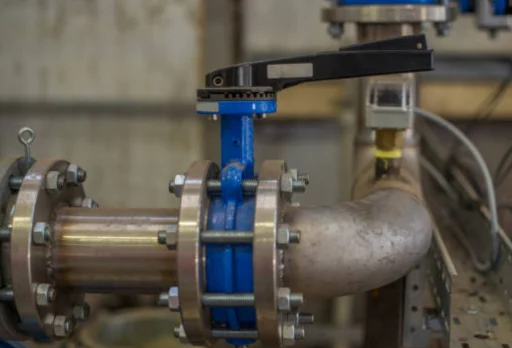
Expert Installation Tips for Complex Piping Layouts
Although the basic teaching is the arrow, piping in the real world is hardly a straight line. Complex layouts add turbulence, cavitation, and non-uniform velocity profiles, which may complicate decisions on flow direction.
- The Rule of Ten and Five: Butterfly valves must preferably be installed with a minimum of ten pipe diameters of straight pipe upstream and five diameters downstream to maintain a steady flow, especially in applications such as water treatment plants. The direction of the flow is even more sensitive when space is limited and a valve has to be installed close to an elbow or a pump.
- Pump Discharge Orientation: When using pumps, the valve may be exposed to high velocity turbulence. The valve should be installed in a horizontal position of the stem. This eliminates the possibility of the bottom of the valve being a trap to the debris and also makes the turbulent flow of a pump or an elbow more uniformly spread over the disc faces.
- Vertical Pipe Flow: When the installation is in a vertical pipe that is flowing downwards, special attention should be paid. When throttling is done with the valve, the mass of the fluid and the velocity may cause a vacuum effect behind the disc resulting in cavitation. In such cases, the direction of choice may have to be reconsidered with the manufacturer to make sure that the disc is not sucked into another position.
- Shaft Orientation in Slurries: In media with solids, the flow direction is to be taken into account in addition to shaft orientation. When the shaft is laid horizontally, the flow will sweep the bottom of the seat as the valve opens, avoiding the buildup of solids that would disrupt the direction of the sealing.
Redefining Precision: The Strategic Advantages of Smart Actuated Systems
While mastering manual installation tips provides a solid foundation, the contemporary industrial plant is becoming more and more precise in its requirements, which cannot be maintained by manual control. The shift between the correct installation and the optimized control is where the real strategic worth of smart automation can be seen. In a conventional manual system, after the valve is installed, it is a black box. You are guessing that it is closing properly by its position, but you cannot actually know this until it leaks or breaks.
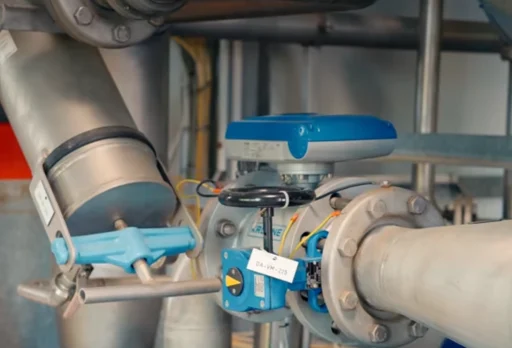
This relationship is redefined by smart actuated systems that transform physical orientation into digital feedback. The smart system allows the valve to monitor the Torque Profile in real-time, which is the most crucial benefit of a smart system. The valve is no longer a passive component; it is a diagnostic tool. When a valve has been fitted in the opposite direction to the desired flow direction, or when the conditions in the pipe vary in such a way that ΔP (pressure drop) varies erratically, the smart actuator will sense the resultant torque deviations. Rather than letting a reverse-flow situation burn out a motor or erode a seat, an intelligent system gives an immediate warning. This shifts the process to a level of reactive maintenance to a level of predictive precision where the system itself can indicate that a directional or sealing problem is occurring before it reaches a critical point. Importantly, in case these mechanical stresses surpass predetermined safety levels, the actuator performs an autonomous intervention, i.e., it stops functioning immediately to avoid the irreversible damage of the whole assembly.
How Vincer Helps You Solve Complex Flow Challenges
At Vincer, we recognize that a valve is not a standalone component but a critical nexus in a broader industrial architecture. With over 20 years of specialized manufacturing experience in China and ISO certification, our portfolio of 800+ successful projects serves as a testament to our commitment to reliability. We bridge the gap between abstract fluid mechanics and your facility’s concrete demands through continuous R&D, maintaining a qualification rate exceeding 95%.
Our engineering rigor is particularly evident in how we navigate complex flow challenges. Vincer’s team performs exhaustive torque analysis to ensure that every automated valve assembly is perfectly calibrated to the dynamic loads of your specific orientation. By delivering fully integrated electric and pneumatic actuated valve solutions, we eliminate the margin for human error in the field, effectively translating complex fluid logic into measurable process stability. Whether you are dealing with high-cycle chemical processing or large-scale water distribution, Vincer provides the expertise to leverage two decades of industrial knowledge for your next project. If you seek to optimize your infrastructure with high-precision technology, contact Vincer today.
Conclusión
Understanding butterfly valve flow direction is a journey from the simple observation of a cast arrow to a deep appreciation of fluid dynamics and mechanical engineering. While concentric valves offer bi-directional simplicity, the high-performance offset valves that drive our most critical industries demand a more nuanced approach. By correctly decoding the relationship between flow and pressure, engineers can prevent leakage, protect actuators from overload, and ensure the longevity of their infrastructure. The medium’s flow is a river’s current; one can either work in harmony with its momentum or suffer the erosive consequences of resisting its natural path. As we look toward a future of smarter, more automated systems, the foundational principles of correct installation remain the bedrock of industrial excellence. By combining these timeless principles with the advanced automated solutions provided by Vincer, we can achieve a level of precision and reliability that was once the province of theory alone.
 English
  French
  Spanish
  Italian
  German
  Dutch
Dutch  Portuguese
  Korean
  Russian
  Chinese
  Finnish