
导言
The choice of a flow control component is hardly a matter of taste in the demanding field of industrial flow control; it is an engineering optimization exercise. The butterfly valve is one of the most common tools in this area, a quarter-turn rotating motion valve that is employed to stop, regulate, and start the flow. Under this category, the wafer-style and the lug-style butterfly valve are a basic choice point of piping designers and plant engineers. While there are many types of valves available—including ball valves and gate valves—the butterfly design is favored for its compact nature and ability to regulate fluid flow with a minimal pressure drop. The decision has far-reaching consequences on the safety of the system, the maintenance procedures, and the cost of the long-term operation. In complex industrial applications, the wrong decision may trigger critical leakage risks and unexpected system failures, which will eventually compromise the overall performance of the facility and its financial sustainability.
The analysis below gives a detailed technical comparison of these two designs, outlining their structural mechanics, application-specific benefits, and the strategic need to shift to automated control systems to increase reliability.
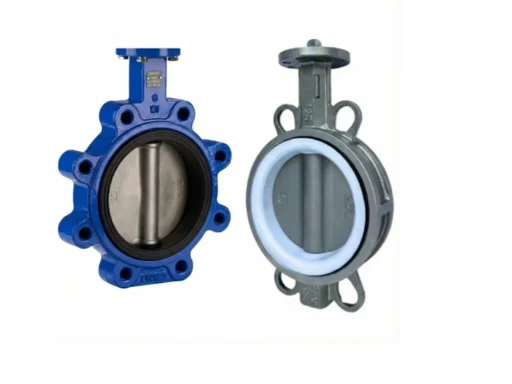
What Is Wafer Butterfly Valve
Wafer-style butterfly valve is made to ensure that there is a seal against the bi-directional pressure difference to avoid backflow in the unidirectional flow systems. It is defined by its thin, compact shape. The wafer valve is physically devoid of threaded points of attachment on its body. Rather, it is intended to be “sandwiched” between two pipe flanges.
The main role of the wafer valve is to offer a lightweight and affordable flow isolation solution. It is designed with a series of centering holes, usually two or four, that are only used to position the valve body in the pipe flanges during the installation process. Since the valve body is not directly clamped to the piping, the whole assembly is dependent on the compressive force of long bolts that run through the flanges and the valve body at the same time.
What Is a Lug Butterfly Valve
Conversely, the lug-style butterfly valve has metal protrusions or lugs on the valve body circumference. These lugs have tapped, threaded holes that match the pattern of the bolts in the mating flanges. The lug valve is attached to each flange separately with two sets of shorter bolts (one set on each side), unlike the wafer design, which is compressed in place.
This mechanical autonomy enables the lug valve to be used as an independent element in the pipeline. Since the bolts are threaded into the valve body, one side of the piping can be disconnected without affecting the structural integrity or the sealing ability of the other side. This architectural distinction transforms the lug valve from a mere isolation device to a vital safety and maintenance device in sophisticated industrial systems.
At a Glance: Wafer vs. Lug Butterfly Valve Comparison Table
特点 | 晶片 蝶阀 | Lug 蝶阀 |
结构 | Clamped between flanges like a “sandwich.” | Body features threaded holes for independent securing. |
Bolting | Fewer bolts required, but they must be very long. | Bolt count is double that of the wafer style, but they are shorter. |
End-of-Line | Strictly prohibited (Safety Risk). | Fully compatible (Supports downstream removal). |
压力 | Low to moderate; limited by bolt stretch. | Higher pressure rating; excels in surge conditions. |
重量 | Lightweight (approx. 20–30% lighter). | Heavier due to additional body mass and lugs. |
Initial Cost (CAPEX) | $ (Lowest initial investment) | $$ (Premium for machining and material) |
维护 | Requires total system shutdown. | Supports local isolation and uptime. |
启动 | Optimized for manual or lightweight units. | Preferred for high-torque automated systems. |
典型应用 | HVAC, water distribution, irrigation, and swimming pool filtration systems. | Oil and gas, chemical processing, pharmaceutical, and power generation. |
Structural Mechanics Differences: The “Sandwich” Design vs. Threaded Lugs
The difference in the structural mechanics of these two valves lies in their response to the axial loads and internal pressure.
The Wafer Design:
The principle of the wafer valve is based on the principle of external compression. The wafer valve may be imagined to be a thin book between two palms, and when the pressure of the palms is relieved the book drops. The pipe flanges in a piping system are the palms and the long all-thread bolts provide the pressure. Although this design is very efficient in terms of material consumption, it exposes the long bolts to a lot of thermal expansion and contraction. In the long run, these temperature variations may cause slight variations in the tension of the bolts, which may weaken the seal unless it is observed.
The Lug Design:
The lug valve employs a threaded engagement approach. The axial load is more localized and safely distributed by threading bolts directly into the valve body. This avoids the use of extremely long bolts, which increases the risks of thermal bolt stretch. Moreover, the lug design offers a stiffer connection, which is better in systems with high-frequency vibration or mechanical stress. The threaded lugs actually cause the valve to be an extension of the piping structure and not an outsider that is placed between the pipes.

End-of-Line Service: Why Lug and Wafer Valves Differ in Safety
The ability to service at the end of the line is one of the most important differences in valve engineering. This is a situation in which the valve is fitted at the end of a run of pipes and the downstream piping is removed, leaving the valve open to the atmosphere on one side and maintaining back pressure on the other.
"(《世界人权宣言》) 安全 Risk of Wafer Valves:
End-of-line service should not use a wafer-style valve. Since it is based on the compression of two flanges to remain in position, the removal of the downstream flange would result in the loss of the clamping force of the valve. The valve would either burst instantly or be forced out of the line under pressure, which would be disastrous to the safety of personnel and equipment.
The Lug Valve Advantage:
The lug-style valve is designed to meet this need. As the valve is attached separately to the upstream flange, the downstream piping may be disconnected to maintain, clean or modify without the valve being disturbed, maintaining the system pressure. This is necessary in refineries, chemical processing plants and any other environment where system-wide shutdowns are not allowed to be made to do minor downstream repairs.
Installation and Maintenance Differences: Balancing Cost and Downtime
The Total Cost of Ownership (TCO) of any piping system is mainly driven by maintenance efficiency. The construction and the maintenance of these valves have different economic and operational profiles.
The installation of a wafer valve is a relatively fast and easy task due to its lightness and low profile. Nevertheless, it may be difficult to have an ideal fit between the two flanges. Unless the long bolts are tightened evenly, the valve disc will not fit into place and the elastomer liner will wear out prematurely. Moreover, since a wafer valve needs the whole part of the pipe to be depressurized and emptied before it can be removed, it places a binary maintenance schedule on the system, either the entire system is operational, or it is completely offline.
A lug valve is simply a tactical investment in system availability, a more complicated installation in exchange for the capability to isolate equipment without a complete shutdown. Since it enables independent bolting, it enables the isolation of individual equipment, e.g., pumps or tanks, without necessarily having to purge the entire plant. In high-stakes manufacturing, a capability to prevent a twelve-hour system drain-down through the use of a lug valve can save a company tens of thousands of dollars in lost production time. This renders the lug valve a strategic decision in the critical paths in the process flow.
Technical Specification Comparison: Pressure, Weight, and Cost
Evaluating these valves through a quantitative lens reveals a clear trade-off between structural economy and mechanical performance.
The wafer butterfly valve utilizes a minimal, thin-body profile that significantly reduces both material mass and initial acquisition costs. This makes it the logical choice for weight-sensitive or budget-constrained applications, such as HVAC and low-pressure utility lines; its pressure rating is generally restricted to moderate thresholds. Its streamlined design necessitates the use of a few exceptionally long bolts and strictly precludes its use in end-of-line service.
Conversely, the lug-style valve functions as the technical standard for high-pressure industrial processes and hazardous chemical transport. Its heavier mass, featuring integrated threaded lugs, facilitates independent bolting and full end-of-line compatibility. While the lug design incurs higher costs due to complex machining and requires a double set of shorter bolts, it provides superior structural integrity during pressure surges. Ultimately, where the wafer valve prioritizes economy and simplicity, the lug valve serves as a robust instrument for environments where reliability is paramount.
Application Differences: When to Use Wafer vs. Lug Butterfly Valves
The choice of the application depends on the complexity of the media, system pressure, and process criticality.
Wafer Valve Applications:
They are most commonly used in water supply systems, swimming pool filtration, irrigation, and low-pressure HVAC (Heating, Ventilation, and Air Conditioning) systems. They are simple and inexpensive and therefore suitable in systems where the media is non-hazardous and the pressure is relatively constant. In such situations, the failure to do end-of-line service is not a disadvantage, since such systems are frequently intended to be shut down completely during the season.
Lug Valve Applications:
These are the workhorses of the oil and gas industry, pharmaceutical manufacturing and power generation. The fact that a pump can be isolated or a tank can be isolated to allow maintenance to be performed and the rest of the facility can continue to operate is not merely a convenience in these sectors, but a necessity. Moreover, the lugged connection is an essential environmental protection in systems that deal with volatile or toxic chemicals. The lug valve is also used in large-scale water treatment plants where large volumes of water flow and the possibility of water hammer effects demand a valve body capable of sustaining high levels of mechanical stress without moving between the flanges.

How to Choose Between Wafer and Lug Butterfly Valves
The selection of the right valve involves a multi-axial analysis of the piping environment.
Evaluate Your Budget and Installation Area:
When the project has a strict budget and the system architecture is basic, the wafer valve can save a lot of money in component cost and shipping/handling because of its weight. The thin profile of the wafer valve is frequently the only option in small skid designs where the face-to-face dimension is critical.
Test Maintenance and End-of-Line Requirements:
Does your system need to be cleaned on a regular basis of individual parts? Do you ever have to change a pump without emptying the tank? If the answer is yes, the only answer that is responsible is the lug valve. The choice of a wafer valve in a situation where end-of-line isolation is needed is an engineering fault that endangers the safety of the site.
Take into account Operating Pressure and 环境 Stability:
The lug valve offers a stronger mechanical interface in high-vibration environments, like around large compressors, or systems with high-pressure spikes. The threaded connection is such that the valve is centered and closed even when the piping is exposed to external forces.
Select the Actuation Method and Mounting Stability:
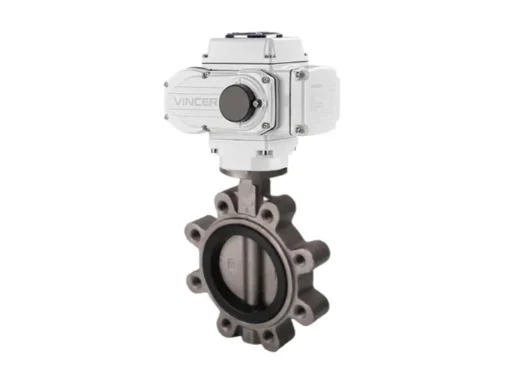
One of the aspects that is often ignored is the way the valve is going to be operated. Manual levers are easy, but as the process shifts to automated control, the valve body is the basis of the process. Automation is the cognitive center of the industrial body and this center needs a stable base. Lug valves, being rigid and bolted-down, offer a far more stable base to high-torque electric or pneumatic actuators. This stability eliminates the problem of valve wander when high-frequency cycling is involved, which otherwise may cause premature wear of the seal in wafer-style installations.
Strategic Reliability: Addressing Manual Limitations with Automated Solutions
While the debate between wafer and lug focuses on the physical connection, the modern industrial landscape is shifting toward a more profound evolution: the transition from manual to automated control. Traditional manual operation, while reliable in simple contexts, introduces a significant variable of human error. In high-frequency operations, a manual valve is often a bottleneck; a technician can only turn a handwheel so fast, and the repeatability of the seal is inconsistent.
A strategic upgrade to automated control addresses these inherent limitations. By integrating pneumatic or electric actuators onto the butterfly valve body, operators can achieve remote monitoring, emergency fail-safe shutdowns, and precise throttling that manual labor cannot match. Automation ensures that flow adjustments are made with mathematical precision, reducing the risk of water hammer or pressure surges caused by rapid manual closing. This transition is no longer a luxury; it is the modern standard for reducing the Total Cost of Ownership and ensuring that a minor operational oversight does not escalate into a system-wide failure.
Why Vincer is Your Trusted Partner for Automated Butterfly Valve Solutions
Vincer is dedicated to providing intelligent fluid control solutions for the global process industry, specializing in critical sectors such as water treatment, oil and gas, food and pharmaceuticals, and new energy. Our commitment extends beyond simple valve supply; we serve as a strategic bridge between traditional engineering and modern automation.
Our core business is a professional team of more than 10 engineers with an average of 10+ years of industry experience. This technical insight enables us to perform a strict 8-dimensional analysis, assessing media, temperature, pressure, connection standards, control methods, and material compatibility, to create solutions that are specifically designed to fit your operational environment. We prioritize the “right fit” over the “standard sale,” ensuring maximum cost-effectiveness and reliability.
Moreover, the commitment to quality is supported by a strong set of international certifications, such as ISO 9001, CE, RoHS, SIL, and FDA. Whether achieving high-performance product functionality or delivering comprehensive technical support, Vincer ensures your system meets the most demanding global safety protocols, making us the ultimate partner for sustainable industrial performance.
结论
The decision between a wafer and a lug butterfly valve is a fundamental decision that reverberates throughout the life of a piping system. The wafer valve is a lightweight, elegant, and simple isolation solution, whereas the lug valve is the structural independence and safety needed in critical maintenance and high-pressure service. But the choice of hardware is only the start. In order to maximize a facility, it is necessary to look past the type of connection to the strategic advantages of automation. By choosing the correct valve body and pairing it with Vincer’s advanced automated control solutions, engineers can guarantee their systems are not only resistant to mechanical breakdown but also efficient in their operation, which will guarantee them a future of high precision and reliability in their flow control.
 English
  French
  Spanish
  Italian
  German
  Dutch
Dutch  Portuguese
  Korean
  Russian
  Chinese
  Finnish